
- Providing world class service and value for employee benefit group plans since 1987

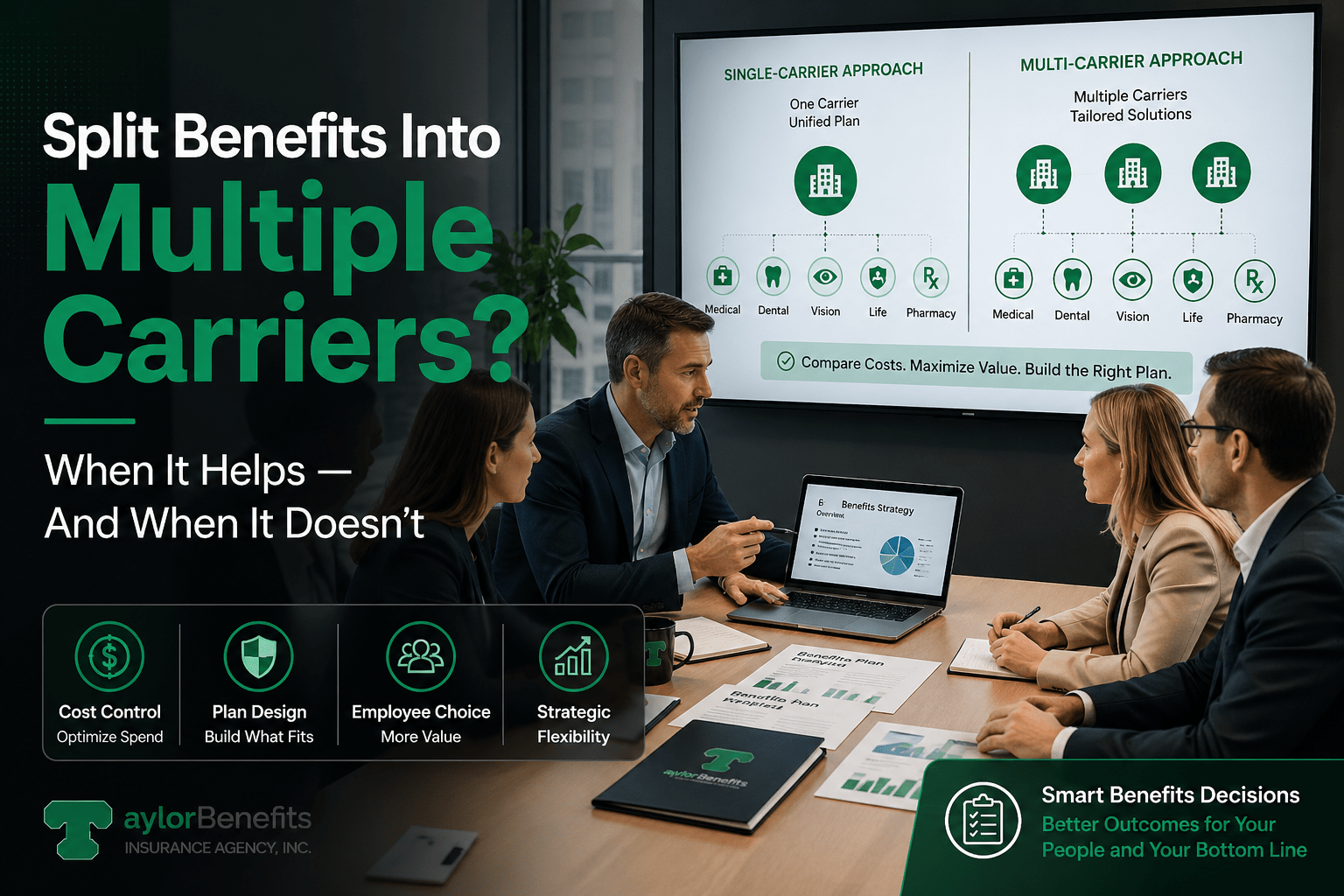
The default assumption among many small and mid-size employers is that bundling all benefits with a single carrier is simpler, cheaper, and easier to manage. The single-carrier model — medical, dental, vision, life, and disability all from the same insurer — has been the standard offering of national carrier sales teams for decades, and the convenience case for it is real.
The cost case is less convincing than it appears. The carrier with the most competitive medical pricing in your market is almost never the carrier with the most competitive dental pricing, the strongest specialty pharmacy program, or the best disability claims management. Bundling discounts — when they exist at all — typically range from 2 to 5 percent on ancillary lines, which sounds material until you compare it to the 15 to 30 percent pricing variance that exists between best-in-class and average vendors in any single ancillary category.
Splitting benefits across multiple carriers — sometimes called “unbundling” — is the strategic alternative. Done well, it captures meaningful cost savings, improves the quality of each individual benefit line, and gives the employer more leverage in renewal negotiations. Done poorly, it creates administrative complexity that erodes the savings, fragments employee experience, and overwhelms HR teams that aren’t equipped to manage multiple vendor relationships.
The difference between the two outcomes is mostly about knowing when each model fits and what infrastructure you need to make multi-carrier work. This article covers both.
Before evaluating the decision, it helps to be precise about what’s being decided. The benefits stack at most employers includes some combination of:
In a fully bundled arrangement, an employer purchases medical, dental, vision, life, and disability from a single carrier — typically a national insurer that offers all five lines. The carrier may also bundle the EAP and ancillary voluntary products. Pharmacy is typically included within the medical plan rather than separately bundled.
In a fully unbundled arrangement, the employer purchases each line from the most competitive specialist vendor — for example, medical from a national carrier, dental from a specialty dental carrier, vision from a specialty vision carrier, life from a life specialist, disability from a disability specialist, and pharmacy carved out to an independent PBM.
Most employers operate somewhere on the spectrum between full bundling and full unbundling. The strategic question is where on that spectrum the employer should be — and the answer depends on group size, internal HR capacity, plan structure, and the specific dynamics of each benefit line in the employer’s market.

The argument for splitting benefits across multiple carriers comes down to four specific advantages.
National medical carriers offer dental, vision, and life as ancillary products — but these aren’t their primary expertise. Specialty carriers focused exclusively on dental, vision, or disability typically offer:
The pricing differential is often substantial. Independent benchmarking of specialty dental and vision carriers consistently shows pricing 10 to 25 percent below the equivalent ancillary plans from major medical carriers, with comparable or better network access.
Pharmacy benefit management is the highest-leverage carve-out opportunity for self-funded and level-funded employers above 200 employees. When pharmacy is bundled within a medical plan, the PBM relationship is typically owned by the medical carrier — meaning the carrier captures rebate value, controls formulary decisions, and has limited incentive to maximize the rebate passthrough or transparency that benefits the plan sponsor.
Carving pharmacy out to an independent PBM — particularly one of the new generation of transparent, pass-through PBMs — gives the employer:
The economic case for pharmacy carve-out is well established at scale. For self-funded employers above 200 employees, the typical carve-out generates 8 to 15 percent in pharmacy cost savings in the first year, with ongoing savings through transparent rebate passthrough.
Long-term disability claims management is an area where specialist carriers materially outperform bundled offerings. The claims management process for LTD — including return-to-work programs, vocational rehabilitation, and ongoing claim review — directly affects both claim outcomes for employees and total claim cost for the employer. Specialist carriers invest in claims infrastructure that bundled offerings often don’t match.
For employers with workforces that include physically demanding work, knowledge work prone to mental health-related disability claims, or above-average disability claim experience, the difference between best-in-class disability claims management and adequate disability claims management can be substantial — both in employee satisfaction and in total claims cost.
When all benefits are bundled with a single carrier, the renewal conversation is one-sided. Walking away means moving every benefit, which is operationally disruptive. The carrier knows this and prices accordingly.
When benefits are split across multiple carriers, each renewal is independent. Aggressive pricing on dental doesn’t depend on satisfaction with medical. Negotiating disability without losing the medical relationship preserves the negotiation. The structural shift in leverage is meaningful, particularly at multi-year intervals when the cumulative effect of competitive pricing across multiple lines compounds.

The case for bundling isn’t purely about carrier sales preferences. There are real situations where a bundled approach delivers more value than splitting would.
For employers under 25 employees, the administrative cost of managing multiple carrier relationships — separate enrollment processes, separate billing reconciliation, separate reporting requirements, separate vendor service issues — typically exceeds the savings available from splitting. A single-carrier bundle that simplifies administration to a single relationship has real value when there’s no dedicated benefits administrator on the HR team.
The threshold isn’t a hard number, but employers below 25 to 50 employees with an HR team consisting of one generalist who also manages payroll, recruiting, and compliance are generally better served by simpler bundled arrangements unless the savings from splitting are particularly large.
While most bundling discounts are modest, some carriers offer meaningful discounts — particularly on ancillary lines — when the employer commits to multiple lines simultaneously. These discounts are most often available at small to mid-size group levels (50 to 200 employees) where carriers are competing aggressively for the entire benefits relationship rather than just individual lines.
When evaluating bundling, ask carriers explicitly what the bundled pricing is versus the standalone pricing for each line. Compare the bundled pricing against the best available standalone pricing in each individual line from specialist carriers. If the bundled discount is genuinely larger than the specialist discount, bundling may be the better choice.
When medical and dental are with the same carrier, certain coordination scenarios — particularly involving accident-related care that may have both medical and dental components — can be administratively simpler. Coordination of benefits between separate carriers is workable but requires more administrative attention.
For most employers, this coordination benefit is modest and rarely outweighs the cost and quality benefits of unbundling. But for specific industries with high accident-related claim coordination — construction, manufacturing, transportation — it can be a real consideration.
Some carriers offer integrated member portals, single ID cards covering multiple benefit lines, and unified customer service experiences that can meaningfully improve employee satisfaction with the overall benefits program. This is most valuable when the employer’s workforce includes a high percentage of employees less comfortable navigating multiple online portals or carrier relationships.

The right unbundling strategy depends on a sequenced analysis that starts with the highest-leverage decisions and works down to lower-impact lines.
For employers above 200 employees on self-funded or level-funded medical plans, pharmacy carve-out is typically the single highest-impact unbundling decision. Run the analysis first because it has the largest potential cost impact and because it informs the broader structure of the medical plan relationship.
The analysis requires comparing the projected total pharmacy cost under the bundled medical/PBM arrangement against quotes from independent PBMs, with particular attention to:
If the analysis shows material savings (typically 8 percent or more on total pharmacy spend) and the employer has the administrative capacity to manage a separate PBM relationship, pharmacy carve-out is generally the right move.
Dental and vision are the easiest unbundling decisions for most employers. The administrative burden of separate dental and vision carriers is modest, the cost savings from specialist carriers are typically meaningful, and the network depth from specialty dental and vision carriers is consistently better than from ancillary offerings.
Run a market-rate comparison every two to three years between your current dental and vision carriers and the best specialty carriers in your market. If specialist carriers can deliver materially better pricing or network access, switching is generally worth the modest administrative effort.
Disability and life insurance are the lines where specialist carrier value is most situation-dependent. For employers with average claims experience and standard workforces, ancillary disability and life from a major medical carrier may be perfectly competitive. For employers with above-average disability claims experience, physically demanding workforces, or specific industry risk profiles, specialist carriers can deliver materially better outcomes.
The analysis here should include not just pricing but claims management quality, return-to-work program effectiveness, and member service ratings — factors that may not be apparent in a pure rate comparison.
Voluntary benefits — accident insurance, critical illness, hospital indemnity, legal, identity protection — are typically best sourced separately from the medical carrier. Voluntary benefit specialists offer broader product portfolios, better employee education and enrollment infrastructure, and more competitive pricing in their specialty lines.
For most employers above 50 employees, voluntary benefits should be sourced from a dedicated voluntary benefits provider rather than as an add-on to the medical carrier relationship.
EAP services are often the lowest-priority unbundling decision but worth examining. Standalone EAP providers typically offer more sophisticated mental health triage, broader counselor networks, and more comprehensive work-life support than EAPs bundled with medical carriers — at modest cost differentials.
For employers with active mental health benefits strategies, a standalone EAP from a specialist provider is typically the right choice. For employers using the EAP primarily as a basic compliance and crisis resource, bundled EAPs are often adequate.

Splitting benefits across multiple carriers only delivers its potential value if the supporting infrastructure is in place. Without this infrastructure, the administrative friction can erode the savings.
A modern benefits administration platform that can manage enrollment, eligibility, and ongoing administration across multiple carriers is essential for any unbundled strategy. The platform handles the data transmission, eligibility synchronization, and reporting that would otherwise consume significant HR time when managed manually across multiple carrier portals.
For employers above 50 employees pursuing meaningful unbundling, the benefits administration platform investment is non-negotiable. Below that size, the cost-benefit calculation depends on the specific platform pricing and the scope of the unbundling strategy.
The broker relationship matters more in unbundled arrangements than in bundled ones. The broker is responsible for:
Brokers oriented around single-carrier bundled solutions are not equipped to manage multi-carrier unbundled arrangements effectively. Confirm broker capability and infrastructure before committing to an unbundling strategy.
Internally, multi-carrier arrangements require clear ownership of vendor relationships — who manages each carrier, who handles employee escalations, who coordinates open enrollment messaging across multiple lines. For employers without dedicated benefits administration staff, this typically means the broker assumes more of the day-to-day vendor management role and the internal HR function focuses on strategy and employee communication.
The most common employee complaint about multi-carrier benefits programs isn’t the multiple carriers themselves — it’s confusing or fragmented communication that leaves employees unsure which carrier handles what. A unified benefits portal, consolidated annual benefits guide, and single employee-facing point of contact for benefits questions all become more important when the underlying carrier landscape is more complex.

To make the framework concrete, here is how the unbundling decision typically plays out at different employer sizes:
The bundled-versus-unbundled decision is not a matter of philosophy or carrier loyalty. It’s a practical analysis of where unbundling captures value, where bundling delivers genuine convenience benefits, and whether the employer has the administrative infrastructure to make multi-carrier work.
For most employers above 50 to 75 employees, selective unbundling — particularly of dental, vision, voluntary benefits, and (for self-funded plans) pharmacy — captures meaningful value with manageable administrative complexity. For employers above 200 employees, broader unbundling typically becomes the right approach. For very small employers without dedicated benefits administration capacity, bundled arrangements remain defensible.
What’s almost never right is defaulting to either model without analysis. The bundled package your current carrier renews each year may be cost-competitive, or it may be 15 to 20 percent above market on the ancillary lines. The only way to know is to run the comparison.
Taylor Benefits Insurance Agency conducts comprehensive carrier strategy reviews for employers across funding structures and group sizes — including line-by-line market comparisons that identify where unbundling captures value and where bundling makes sense to retain. Contact our team if you’d like an objective assessment of your current carrier arrangement.
If your HR team is small or already stretched, splitting plans can quickly add extra coordination work. Managing separate billing, renewals, and employee questions often takes more time than expected. Once that workload outweighs the savings from better pricing, a single carrier setup may actually be the more practical choice.
Managing several carriers can increase administrative work, complicate claims coordination, and create inconsistent employee experiences. Employers should weigh these challenges against potential cost savings and plan flexibility.

Todd Taylor oversees most of the marketing and client administration for the agency with help of an incredible team. Todd is a seasoned benefits insurance broker with over 35 years of industry experience. As the Founder and CEO of Taylor Benefits Insurance Agency, Inc., he provides strategic consultations and high-quality support to ensure his clients’ competitive position in the market.

We just started working with Taylor Benefits and could not be happier. Todd gave us quite the education as well as some time saving tools to help us manage our HR and save money too. We are looking forward to a long relationship!”
-Carol, Accounting Manager, recruitment marketing company, Campbell, CA
We’re ready to help! Call today: 800-903-6066