
- Providing world class service and value for employee benefit group plans since 1987

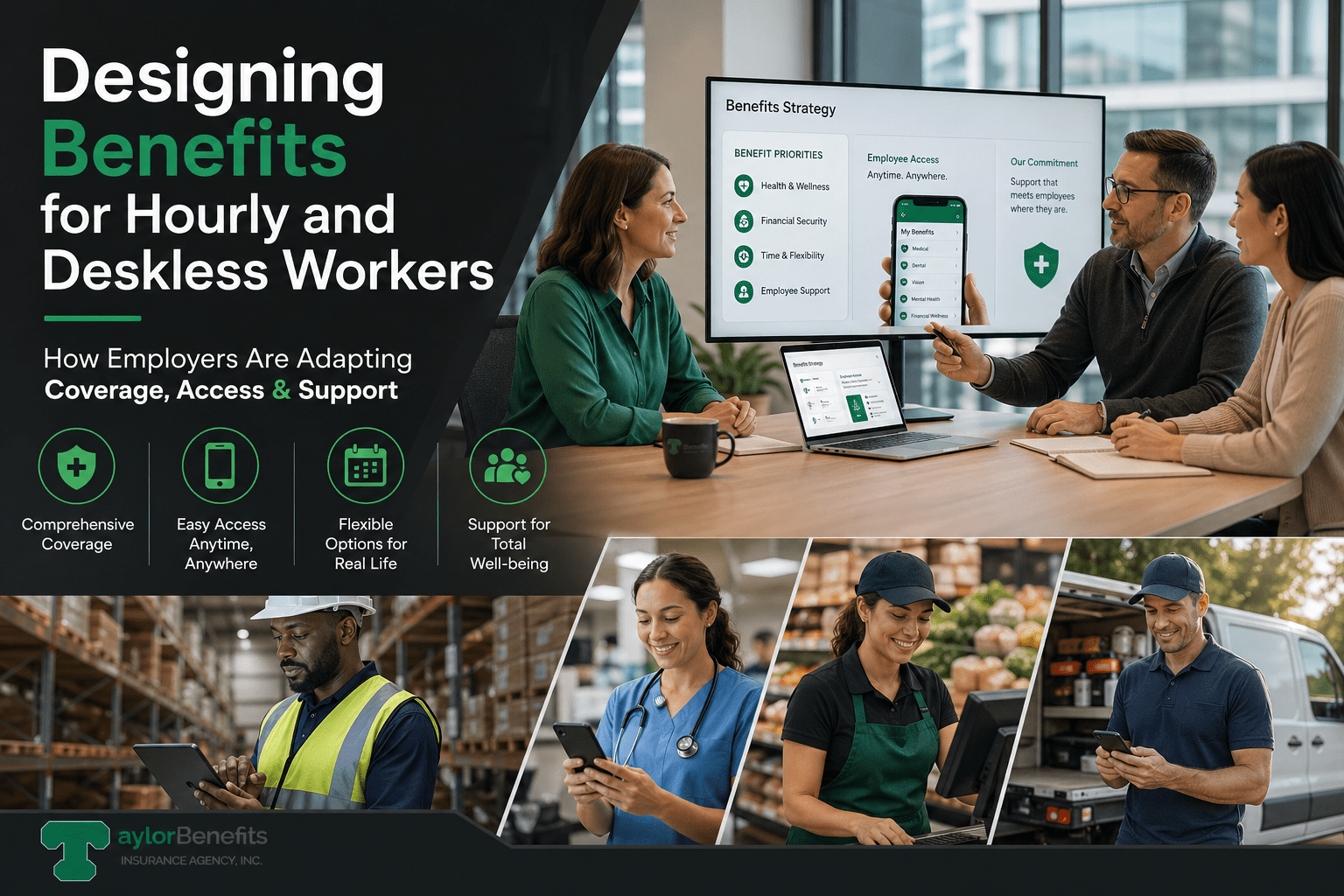
The benefits package designed for a salaried knowledge worker behind a laptop fails predictably when delivered to a warehouse associate, a CNA in a long-term care facility, a delivery driver, a construction worker, or a hospitality worker on a variable schedule. The plan structure, the enrollment process, the communication channels, the claims experience, and the assumptions about how employees access care are all built for a workforce that lives on email, has predictable hours, can take a phone call during the workday, and has a regular relationship with a primary care physician within their carrier’s network.
For deskless and hourly workers — who collectively represent over 80 percent of the global workforce and a majority of the workforce at many U.S. employers in healthcare, retail, hospitality, manufacturing, logistics, food service, and skilled trades — almost none of those assumptions hold. The result is a benefits package that is technically offered but practically inaccessible, and a benefits investment that delivers a fraction of its potential return in retention, productivity, and employee health.
Employers who serve large hourly and deskless populations are increasingly redesigning their benefits programs around the actual conditions of their workforce — not as a charitable accommodation, but as a strategic response to the retention, recruitment, and operational stakes of getting it right. This article covers what those employers are doing differently and what other employers can learn from their approach.
Before describing what works, it’s worth being precise about what fails. The gap between offered benefits and actually used benefits is wider for hourly and deskless populations than for any other workforce segment, and the reasons are structural rather than attitudinal.
Enrollment friction. Standard open enrollment processes assume employees have email access, time during the workday for a 30-minute enrollment session, and a comfort level with online benefits portals. A line worker on a manufacturing floor has none of those assumptions. Without active intervention, default-only enrollment patterns produce participation rates substantially below salaried workforce equivalents — particularly in voluntary benefits, retirement plans, and HSAs that require employee election.
Affordability mismatch. Premium contributions calibrated to salaried compensation can represent a punishing percentage of take-home pay for an hourly worker earning $18 to $25 per hour. A $200 monthly employee premium that represents 1 percent of a salaried employee’s gross pay represents 4 to 5 percent of an hourly worker’s take-home pay. Deductible amounts that feel manageable to a salaried employee can be financially catastrophic to an hourly employee with limited cash reserves.
Care access barriers. Standard plan designs assume employees can take time off during business hours for medical appointments. Hourly workers — particularly those on shift schedules, in roles without paid sick leave, or in tight-coverage operational environments — face direct income loss when they take time off for care. The result is delayed care, reliance on emergency rooms when conditions become acute, and worse health outcomes that translate into higher long-term claims costs.
Communication mismatch. Open enrollment communications delivered exclusively via email or company intranet reach a fraction of deskless workers. Benefits questions that require calling an HR line during business hours go unanswered for shift workers. Year-round benefits engagement that depends on digital channels misses the workers who would benefit most from understanding their plan.
Eligibility gaps. Variable-hour workers — particularly those whose hours fluctuate around the 30-hour-per-week ACA full-time threshold — may face eligibility uncertainty, coverage gaps during slow periods, or churning between covered and uncovered status that undermines plan continuity.
These structural failures aren’t fixed by adding more benefit options. They’re fixed by redesigning the benefits architecture, the enrollment experience, the communication channels, and the cost-sharing structure around the actual conditions of deskless and hourly work.

The plan design choices that reduce barriers for hourly and deskless workers fall into a few distinct categories.
The high-deductible health plan (HDHP) is the dominant structure in the U.S. employer market in part because it lowers premium costs while shifting initial cost-sharing to employees. For employees with cash reserves to cover the deductible — typically salaried workers with HSAs — the structure works. For hourly workers without cash reserves, the same structure creates a direct disincentive to seek care, with predictable downstream consequences.
Employers with significant hourly populations are increasingly offering at least one plan option with a substantially lower deductible — often paired with copay-based cost-sharing for primary care, urgent care, and specialist visits — even when that plan carries a higher premium than the HDHP alternative. The financial logic is straightforward: if a $35 copay gets an hourly worker to seek primary care for an emerging condition before it requires an emergency room visit or hospital admission, the plan saves substantially more than the premium differential costs.
The implementation choice typically takes one of two forms:
A traditional copay PPO option alongside an HDHP option, with employees choosing the plan that fits their financial situation. This preserves HDHP availability for employees who prefer it (particularly salaried workers who use the HSA) while providing a lower-friction option for hourly workers.
A “minimum value plus” plan design that meets ACA minimum value requirements but with deductibles and out-of-pocket maximums set well below the federal maximums — for example, a $1,500 deductible plan instead of a $3,000 deductible plan — with the cost differential absorbed through plan design rather than employee premium increases.
For lower-wage hourly workers, the gap between an affordable plan and an unaffordable plan is often determined by the employer contribution structure rather than by the underlying premium cost. Employers with significant hourly populations who want meaningful enrollment and access among that workforce typically contribute 75 to 90 percent of employee-only premium for the lowest-cost qualifying plan — substantially above the 50 percent minimum required for ACA Small Business tax credit eligibility and above what most employers contribute toward salaried employee coverage.
The financial logic again favors the higher contribution. Hourly worker turnover is the largest single operational cost for many service-sector employers, and turnover is materially affected by perceived benefits accessibility. An additional 10 percent of premium contribution that increases enrollment and reduces turnover delivers ROI through retention savings that exceeds the direct premium cost.
Some employers go further and offer tiered premium contributions based on wage level — higher employer contribution percentages for lower-wage employees, with the differential absorbed through plan-level cost structure. This approach is structurally more equitable but introduces administrative complexity that not all employers are equipped to manage.
Telehealth utilization has been the most consequential benefits innovation for hourly and deskless workers since the COVID-19 era normalized virtual care. For workers whose access barriers center on time, transportation, and scheduling rather than on cost alone, telehealth removes the largest practical obstacle to seeking care.
Plan designs that include telehealth with zero cost-sharing — or with copays low enough to remove the financial barrier — and that include behavioral health visits within the telehealth benefit, consistently show meaningfully higher utilization rates among hourly workforces than they do among salaried workforces. The benefit, in other words, is most valuable to the employees who face the most access barriers.
For employers building benefits programs around hourly populations, telehealth at zero cost-sharing should be considered a baseline expectation rather than an enhancement.
Prescription cost-sharing is one of the most common reasons employees fail to fill prescriptions or skip doses. For hourly workers managing chronic conditions — diabetes, hypertension, asthma, mental health conditions — even modest copays for generic medications produce documented adherence drops and downstream cost increases.
Many large employers serving hourly populations now offer zero-copay generic prescriptions for chronic disease management medications, often through value-based formulary designs that incentivize adherence to preventive medications. The plan-level cost is modest; the impact on chronic disease outcomes and total medical claims cost is substantial.

The eligibility decisions for variable-hour workforces are among the most consequential benefits choices for hourly populations and are subject to specific ACA rules that frequently confuse employers.
For employees with variable hours that may fluctuate around the 30-hour-per-week full-time threshold, the ACA permits employers to use a “look-back measurement method” — measuring an employee’s average hours over a defined past period (typically 6 to 12 months) to determine eligibility for a defined future stability period.
This method provides predictability for both employer and employee: an employee who averaged 30+ hours per week during the measurement period receives full-time status for the entire stability period regardless of week-to-week fluctuations during the stability period. For variable-hour workforces, the look-back method is generally administratively simpler and more equitable than the alternative monthly measurement method.
The choice of measurement period length, stability period length, and administrative period length involves tradeoffs that should be made deliberately based on workforce characteristics. Work with a broker or ERISA counsel experienced in variable-hour eligibility to set the methodology appropriately.
Hourly workforces typically experience higher turnover and more frequent transitions between employers than salaried populations. For employees in lower-wage roles, coverage gaps between jobs can cascade into significant medical events — including delayed treatment for conditions that were being managed under prior coverage.
Employers serving hourly populations are increasingly providing more proactive support for coverage transitions:
These accommodations cost the employer little but materially reduce the harm of coverage transitions for departing employees — and improve the employer’s brand as a place that treats workers well even on departure.
 Communication and Enrollment Strategies That Reach Deskless Workers
Plan design improvements only deliver value if employees actually understand and enroll in their benefits. The communication and enrollment infrastructure for deskless workers needs to be built around the reality of how those employees actually access information.
Deskless workers overwhelmingly access digital information through personal mobile devices rather than employer-provided computers. Benefits administration platforms designed primarily for desktop use create immediate friction. Employers prioritizing access for deskless populations should evaluate benefits platforms specifically on their mobile experience — mobile app availability, mobile-optimized enrollment flows, mobile push notification capabilities for enrollment reminders, and mobile access to plan information and ID cards.
A benefits platform that requires desktop access to complete enrollment will produce participation rates among deskless workers that lag salaried equivalents by a substantial margin.
For workforces with significant in-person presence — manufacturing, healthcare, retail, hospitality, distribution — on-site enrollment support during open enrollment is one of the highest-impact engagement investments available. Bringing benefits counselors to break rooms, shift change locations, and operational facilities — and conducting one-on-one or small-group enrollment sessions during paid time — consistently increases participation in voluntary benefits, retirement plans, and properly informed plan selection.
The investment is modest relative to the benefits budget, and the payoff in informed enrollment decisions and increased participation is substantial.
Deskless workforces in many industries include significant non-English-speaking populations and employees with varying levels of comfort with healthcare terminology. Benefits communications written in standard insurance industry language exclude these employees by default.
The accessibility commitments that work:
Annual benefits communication once per year at open enrollment reaches a fraction of the deskless workforce. Year-round engagement through the operational communication channels employees already use — manager briefings, shift-start huddles, break-room digital signage, payroll stuffers, mobile app notifications — keeps benefits awareness present throughout the year and meaningfully increases utilization of underused benefits like EAP, telehealth, and preventive care.
The most effective programs treat benefits communication as an ongoing operational discipline rather than an annual event.
The benefits priorities for hourly and deskless workers typically extend beyond health insurance to include several categories that may be underemphasized in benefits packages designed for salaried populations.
Earned wage access (EWA) — also called on-demand pay — allows employees to access wages they have earned but not yet been paid through the standard pay cycle. For hourly workers managing tight cash flow, EWA can substantially reduce reliance on payday loans, overdraft fees, and other high-cost short-term financing. EWA platforms typically operate at zero direct cost to the employer (with employees paying modest per-transaction fees or with the platform absorbed as a benefits expense) and consistently rank among the most-used benefits when offered to hourly populations.
Employer-sponsored emergency savings programs — often structured as automatic payroll deductions into separate savings accounts — directly address the financial fragility that drives many of the access problems hourly workers face with traditional benefits. SECURE 2.0 enabled new structures for employer-sponsored emergency savings tied to retirement plans, and standalone emergency savings products have proliferated in the benefits market.
For workforces where a $400 unexpected expense would be financially destabilizing for a substantial percentage of employees, emergency savings programs deliver real financial wellness value at modest cost.
Hourly and deskless workforces often include disproportionate representation of employees with significant caregiving responsibilities — parents managing childcare on variable shift schedules, employees caring for aging parents, employees navigating dependent care for family members with health conditions. Caregiving benefits — backup childcare, eldercare navigation, dependent care FSA contributions, and flexible scheduling support — directly address the operational realities that drive turnover in these populations.
For hourly workforces with upward mobility aspirations, tuition assistance and skills development benefits directly support the career progression that converts hourly employees into longer-term retained employees. Employer-provided tuition assistance up to $5,250 per year is currently excluded from employee taxable income under IRC Section 127, making it one of the most tax-efficient benefits available.
For workforces in locations with limited public transit or in roles requiring early-morning, late-night, or weekend hours when transit is reduced, transportation support — commuter benefits, ride-share subsidies, parking assistance — addresses a practical barrier to employment that affects retention directly.

The benefits programs that work for salaried knowledge workers were not designed with deskless and hourly populations in mind, and they predictably underperform when applied to those workforces. The gap shows up in lower enrollment, lower utilization, lower benefits satisfaction, higher turnover, and worse health outcomes that translate into higher long-term claims costs.
Closing that gap requires deliberate design choices: lower-deductible plan options paired with adequate employer contributions, embedded telehealth and zero-cost generic prescriptions for chronic disease management, eligibility structures that work for variable-hour workforces, communication and enrollment infrastructure built for mobile-first deskless populations, and benefit categories beyond health insurance that address the financial fragility and operational realities of hourly work.
For employers whose workforces include significant hourly and deskless populations — which describes the majority of employers in healthcare, retail, hospitality, manufacturing, logistics, food service, and skilled trades — the strategic question is not whether to redesign benefits around these workers, but how quickly. The retention, recruitment, and operational stakes are substantial, and the employers who get it right are gaining material competitive advantage over those who continue to deliver salaried-workforce benefits to a workforce that doesn’t fit that mold.
Taylor Benefits Insurance Agency works with employers across industries with significant hourly and deskless populations to design benefits programs that deliver real access, real engagement, and real value for the workforces they actually serve. If you’d like to evaluate how your current benefits program is performing for your hourly workforce — and where redesign opportunities exist — contact our team for a consultation.
Workforce composition, ACA eligibility methodology, plan design options, and ancillary benefit availability vary by employer industry, group size, and applicable federal and state law. Consult a qualified benefits advisor and ERISA counsel when designing benefits programs for variable-hour or non-standard workforces.
Deskless workers tend to value practical benefits that directly support daily life. Health coverage, paid time off, flexible scheduling, and financial support tools often rank highest. Many also appreciate faster access to information and simple enrollment processes. When benefits are relevant and easy to use, engagement improves and employees feel more supported.
Mobile enrollment, clear communication, and flexible plan options make benefits easier to access. Simple processes help hourly and deskless employees understand, use, and appreciate their available coverage.

Todd Taylor oversees most of the marketing and client administration for the agency with help of an incredible team. Todd is a seasoned benefits insurance broker with over 35 years of industry experience. As the Founder and CEO of Taylor Benefits Insurance Agency, Inc., he provides strategic consultations and high-quality support to ensure his clients’ competitive position in the market.

We just started working with Taylor Benefits and could not be happier. Todd gave us quite the education as well as some time saving tools to help us manage our HR and save money too. We are looking forward to a long relationship!”
-Carol, Accounting Manager, recruitment marketing company, Campbell, CA
We’re ready to help! Call today: 800-903-6066