
- Providing world class service and value for employee benefit group plans since 1987
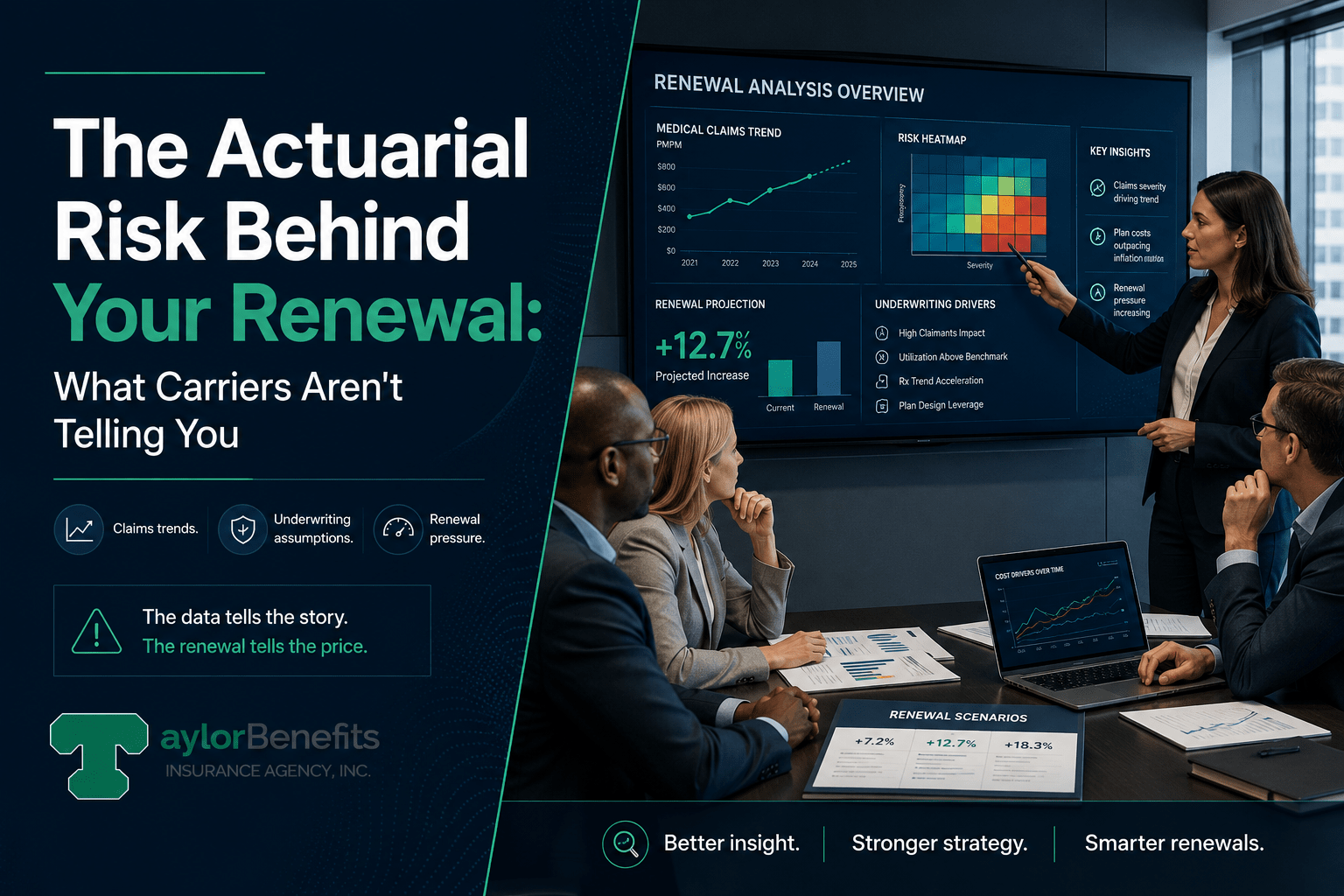
Every year, a renewal proposal arrives from the carrier or TPA. The document shows a rate increase — expressed as a percentage — alongside perhaps a brief explanation citing medical trend, claims experience, or plan adjustments. Most employers review the number, express some degree of frustration, and then proceed to negotiate within whatever margin the broker believes is available.
What most employers don’t see is the actuarial framework underneath that number. Renewal rates are not arbitrary. They are built on assumptions — about projected claims, risk scoring, trend factors, administrative loadings, and profit margins — that carriers apply methodically and that are rarely disclosed in detail to the plan sponsor. Understanding what drives those assumptions is the difference between an employer who reacts to renewal proposals and one who anticipates them, challenges them intelligently, and negotiates from a position of genuine knowledge.
This article covers the key actuarial concepts behind renewal pricing, what carriers are typically not telling employers, and how employers can use this knowledge practically.
A carrier’s renewal rate for a fully insured group health plan is built from several components layered together. Understanding each layer is foundational to understanding what’s negotiable and what isn’t.
The foundation of any renewal rate is projected claims for the coming plan year. The carrier starts with the group’s actual claims experience from the prior period and adjusts it for:
On top of projected claims, the carrier adds an administrative load — often called the non-claims component — covering:
The administrative loading in the small and mid-market fully insured space typically runs 15 to 25 percent of the total premium. Large group plans typically have lower administrative loading (8 to 15 percent). The carrier’s target profit margin is embedded in this loading and is not separately disclosed.

For self-funded plans with stop-loss insurance, the stop-loss carrier adds a risk charge — the actuarial price of the catastrophic claims exposure the carrier is assuming. This charge reflects the group’s risk profile, the stop-loss attachment points selected, and the carrier’s own actuarial assumptions about expected stop-loss trigger frequency.
Several actuarial assumptions that materially affect renewal pricing are routinely not disclosed to plan sponsors.
Understanding the actuarial mechanics helps explain several common renewal patterns that confuse employers.
“Our claims were good this year but our renewal still went up significantly.”
This happens when the carrier’s trend factor and manual rate blend drive the renewal independent of the group’s favorable experience. If the group is small enough to receive significant manual rate weight, the group’s favorable claims may not produce the favorable renewal the employer expected. Asking the broker to obtain the carrier’s credibility factor and trend assumptions is the right response — and should be done before accepting or negotiating the renewal.
“Our claims were unusually high last year due to one large case, and now our renewal reflects that.”
Single catastrophic claims in credibility-weighted groups can materially move renewal rates even when the claim is unlikely to recur. Carriers will sometimes adjust for known non-recurring events if pressed, but they don’t do this automatically. The employer (through the broker) should explicitly identify non-recurring claims and request experience adjustments.
“We’ve been with the same carrier for years and our renewal is always higher than the competition’s initial quotes.”
Incumbent pricing often reflects incumbent advantage — carriers know that switching costs reduce the employer’s negotiating leverage. After several years of consecutive renewals, the carrier’s pricing may have drifted materially above what the same group would receive as a new account. Market quoting — placing the group for competitive bids — is the structural response.
“We moved to an HDHP to control costs, but our renewal still went up materially.”
Plan design changes that reduce claims (through higher employee cost-sharing) can be credited in renewal development when the change is specifically modeled. But carriers don’t automatically pass through the full savings from plan design changes — they may apply a conservative adjustment factor. Requesting the carrier’s specific plan change credit methodology is appropriate when significant plan design modifications have been made.

For self-funded employers, the actuarial picture is different — and the transparency should be higher, but often isn’t.
Stop-loss pricing reflects the carrier’s loss ratio assumptions for your specific risk profile. The premium for specific stop-loss (per-individual) and aggregate stop-loss is set based on the carrier’s actuarial model for the probability and magnitude of claims exceeding your attachment points. For employers with known high-risk members — current oncology patients, members on specialty drugs, members with end-stage renal disease — these assumptions directly drive pricing.
Lasering is actuarial pricing applied to individual members. When a stop-loss carrier applies a laser — a higher attachment point or exclusion for a specific known high-cost member — it is making a specific actuarial judgment that the member’s expected future claims exceed the standard pricing for the attachment point. Negotiating anti-laser provisions or laser caps at inception is far more effective than contesting lasers at renewal.
Aggregate attachment points use projected claims you should verify. The aggregate stop-loss attachment point is typically set at 110 to 125 percent of projected claims. But who sets the projected claims number? The stop-loss carrier uses their own projection, which may or may not reflect your actual claims profile. Employers who have favorable trend history can sometimes negotiate lower aggregate attachment points by presenting their own claims data to the stop-loss carrier.
The actuarial information that shapes renewal pricing is not freely volunteered — but much of it is obtainable if employers know what to ask for.
For fully insured plans, this can be requested through the broker. Carriers may resist disclosing proprietary assumptions, but asking specifically for the blend methodology and trend factors applied to the renewal development opens a conversation that can produce more transparent negotiations.
Rather than accepting a summary renewal offer, request the underlying development — projected claims, administrative loading components, credibility adjustment, and trend factors — in a format that can be reviewed line by line.
Identify any prior-year claims that are clearly non-recurring — the cancer patient who has since recovered, the premature infant who is now healthy, the accident that will not repeat — and ask the carrier to provide adjusted experience that excludes or discounts these claims.
The most effective actuarial challenge to incumbent pricing is competitive intelligence. A competitive quote from another carrier — based on the same group’s risk profile and claims experience — provides direct evidence of whether the incumbent’s renewal is priced appropriately. Employers who quote the market every two to three years systematically prevent pricing drift.
Stop-loss carriers who receive comprehensive, well-presented claims data from the plan sponsor are in a position to price the risk more accurately — and more favorably for groups with genuinely favorable risk profiles. Don’t assume the stop-loss carrier has complete information; provide it proactively.

The renewal rate you receive is not a fact — it is an estimate built on actuarial assumptions that the carrier has applied to your group’s risk profile using methodologies they don’t routinely explain. Some of those assumptions may favor the employer; others may not. None of them are automatically optimal for the plan sponsor.
Employers who understand the actuarial mechanics of renewal pricing — credibility weighting, trend factors, administrative loading, profit margins, and stop-loss pricing — are equipped to ask the right questions, challenge the right assumptions, and negotiate from knowledge rather than from reaction.
The actuarial process isn’t designed to obscure information. But the information isn’t volunteered either. Asking for it is the employer’s job — and understanding why it matters is the foundation for asking the right questions.
Taylor Benefits Insurance Agency works with employer clients to analyze renewal development assumptions, request detailed carrier worksheets, and identify opportunities to challenge renewal pricing based on actual claims performance and market alternatives. Contact our team before your next renewal to understand what’s driving your rate.
Data analysis helps employers understand patterns that may affect future renewal expenses. Reviewing claims history, participation levels, and healthcare trends provides a clearer picture of potential cost changes. This information allows businesses to plan ahead, compare available options, and make decisions based on measurable factors rather than reacting after renewal increases occur.

Todd Taylor oversees most of the marketing and client administration for the agency with help of an incredible team. Todd is a seasoned benefits insurance broker with over 35 years of industry experience. As the Founder and CEO of Taylor Benefits Insurance Agency, Inc., he provides strategic consultations and high-quality support to ensure his clients’ competitive position in the market.

We just started working with Taylor Benefits and could not be happier. Todd gave us quite the education as well as some time saving tools to help us manage our HR and save money too. We are looking forward to a long relationship!”
-Carol, Accounting Manager, recruitment marketing company, Campbell, CA
We’re ready to help! Call today: 800-903-6066