
- Providing world class service and value for employee benefit group plans since 1987

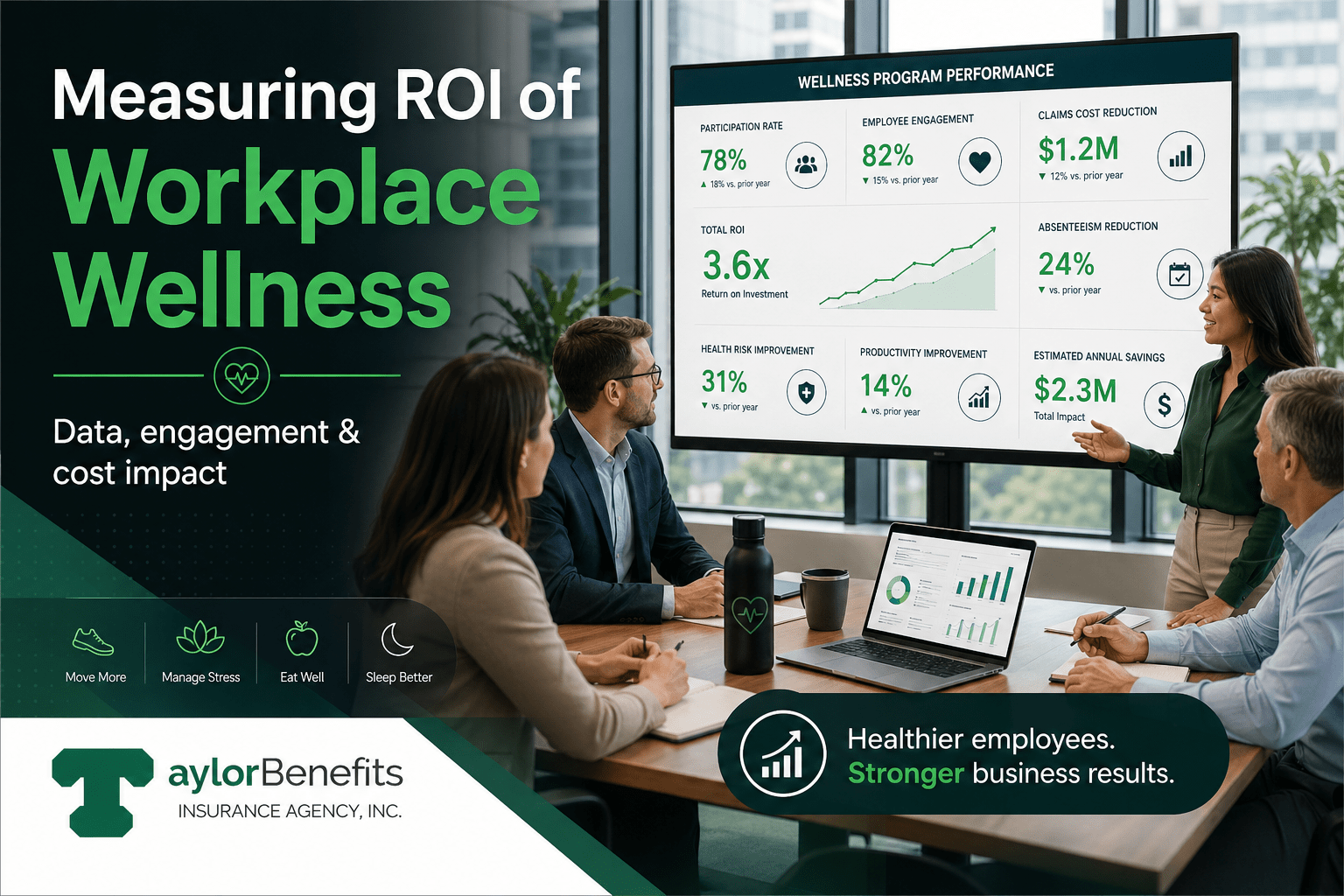
The conversation about workplace wellness ROI has matured significantly over the past decade, and not in a way that flatters most existing programs. The early era of wellness — anchored in claims that every dollar invested returned three to six dollars in healthcare savings — produced numbers that didn’t survive serious academic scrutiny. The peer-reviewed literature, including landmark studies from the University of Chicago and Harvard, has consistently found that the dramatic ROI claims of the 2000s and early 2010s were artifacts of selection bias rather than genuine cost reduction.
That history matters because most HR and benefits leaders presenting wellness programs to their CFOs are still relying on vendor-supplied ROI calculations built on the same flawed methodologies that the academic literature dismantled. The result is a credibility gap: wellness programs that may be delivering real value get presented with numbers that don’t hold up to questioning, and the program ends up evaluated more harshly than its actual performance warrants.
Measuring wellness ROI honestly — using methods that actually track what your program is doing and that survive a CFO’s first round of questions — requires a different framework than most vendors provide. This article lays out that framework: which metrics actually measure value, which methodologies produce defensible numbers, and how to structure a wellness program evaluation that gives leadership a real basis for investment decisions.
The ROI claims that dominated wellness marketing for years — “every dollar invested in wellness returns $3.27 in healthcare cost savings” and similar figures — typically came from one of two methodologies, both of which have serious problems.
Participant-versus-non-participant comparisons. The most common methodology compared healthcare costs of program participants to costs of non-participants in the same workforce. The problem is selection bias: employees who voluntarily enroll in wellness programs are systematically healthier, more health-conscious, and more engaged than non-participants — not because the program made them that way, but because they were already that way before joining. Comparing the two groups measures the pre-existing difference between participants and non-participants, not the impact of the program itself.
Pre-versus-post implementation comparisons. A second common methodology compared total healthcare costs before program launch to costs after launch, attributing any decrease to the program. This methodology ignores secular trends in healthcare costs, regression to the mean (employers typically launch wellness programs after high-cost years and would have seen some cost moderation regardless), and other concurrent changes in the benefits program.
When researchers have applied rigorous methodology — randomized controlled trials and quasi-experimental designs that control for selection bias — the measured impact of typical wellness programs on healthcare costs has been substantially smaller than vendor claims, and in some studies indistinguishable from zero.
This doesn’t mean wellness programs have no value. It means the value they deliver is often in different categories than the simple medical claims reduction story implies, and measuring that value requires methodologies different from what most vendors use.

A defensible wellness ROI evaluation starts with being honest about which value categories the program is actually delivering. Most programs create value in some of these categories and not others — and the measurement approach should match the actual value the program delivers.
This is the category vendor ROI calculations typically focus on, and the category where the academic literature has been most skeptical. Direct healthcare cost impact requires the program to actually change health outcomes — reducing chronic disease prevalence, improving disease management, or shifting care utilization patterns — in a way that translates into lower claims.
Honest assessment: This impact exists for some programs targeting some populations, but it is generally smaller than vendor claims suggest, takes 3 to 5 years to materialize, and is hardest to isolate from other factors affecting claims trends.
Where it’s most likely real: Targeted disease management programs (diabetes management, hypertension management, mental health support) for identified high-risk members — particularly programs that integrate clinical case management rather than relying on generic wellness activities.
Wellness programs can affect workforce productivity through reduced absenteeism, reduced presenteeism (working while sick or impaired), and improved physical and mental energy. For many programs, the productivity value substantially exceeds the direct healthcare cost impact — but it is rarely measured rigorously because most employers don’t have systematic productivity baselines to compare against.
Honest assessment: When measured properly using standardized productivity instruments, well-designed programs do show meaningful productivity improvements. The economic value of those improvements often exceeds direct healthcare cost effects for typical workforces.
Where it’s most likely real: Mental health and stress management programs, ergonomic and musculoskeletal programs in physically demanding workforces, sleep and fatigue management programs in shift-work environments.
Comprehensive benefits programs — including wellness components — affect both recruitment success and voluntary turnover rates. The economic value of even modest improvements in retention is substantial: turnover costs typically run 50 to 200 percent of annual salary depending on the role, and even single-digit-percent improvements in retention translate into material dollar savings for employers above a few hundred employees.
Honest assessment: The retention case for wellness programs is more defensible than the direct healthcare cost case for most programs, but it requires comparing turnover among participants versus non-participants while controlling for the same selection bias issues.
Where it’s most likely real: Programs that genuinely affect employee experience and engagement — high-quality EAP, mental health support, financial wellness, caregiving support — rather than programs centered on health screenings and biometric assessments.
Some wellness program value is harder to monetize but real: improvements in employee engagement scores, manager-employee relationships, and organizational culture. These effects are most evident in employee survey data over multi-year periods and in correlations with other engagement-driven outcomes.
Honest assessment: This category is real but requires multi-year measurement to isolate. It is typically reported alongside other categories rather than as standalone ROI.
Where it’s most likely real: Programs that signal genuine employer investment in employees beyond healthcare cost management — comprehensive mental health support, financial wellness, caregiving support, manager training programs.

Defensible wellness measurement focuses on metrics that can be tracked over time, attributed reasonably to program activities, and compared against meaningful benchmarks. The metrics fall into four tiers.
These metrics measure whether the program is actually being used. They are not ROI metrics on their own — engagement is necessary for impact but not sufficient — but they are foundational. A program with low engagement cannot deliver meaningful outcomes regardless of design.
What good looks like: Enrollment rates above 60 percent for opt-in programs, active utilization above 40 percent of enrollees within any 90-day window, and engagement distributed across age groups, locations, and job levels rather than concentrated in salaried desk workers.
These metrics measure whether the program is producing measurable changes in health status among participants. They are most credible when measured longitudinally for the same population over time.
What good looks like: Statistically significant improvements in target biometric indicators among repeating participants, preventive care completion rates above 75 percent, and mental health utilization rates that grow over time as program awareness and trust increase.
These metrics measure the program’s impact on workforce productivity, attendance, and retention — the categories where wellness programs often deliver their largest economic value.
What good looks like: Stable or improving absenteeism trends over multi-year periods, lower-than-benchmark short-term disability incidence, voluntary turnover rates that compare favorably to industry benchmarks.
These metrics measure direct healthcare cost impact — the category the academic literature has been most skeptical of, but still relevant when measured rigorously.
What good looks like: Cost trends below applicable benchmarks, declining ER utilization for non-emergency conditions, and improving pharmacy adherence among members with chronic conditions.
 Methodology That Survives a CFO’s Questions
The metrics above are necessary but not sufficient. The methodology used to attribute changes in those metrics to the wellness program — rather than to other concurrent factors — is what determines whether the resulting ROI calculation is credible.
Vendor methodologies that compare program participants to non-participants in the same employer population produce inflated results due to selection bias. Better methodologies include:
Comparison to similar non-participating employer populations. If your wellness vendor or benefits consultant has access to benchmark data from comparable employers without similar wellness programs, comparing your trends against that benchmark population provides better attribution.
Difference-in-differences analysis. Comparing the change in metrics in your wellness population against the change in metrics in a comparable non-program population over the same time period controls for secular trends affecting both groups.
Propensity score matching. For sophisticated analyses, propensity score matching constructs a comparison group of non-participants statistically matched to participants on observable characteristics (age, gender, baseline health status, claims history) — reducing but not eliminating selection bias.
For most employer-level analysis, full academic rigor is impractical. The key is acknowledging the methodology’s limitations rather than ignoring them — presenting results with appropriate confidence intervals and noting where attribution is uncertain.
Wellness program impacts on healthcare costs typically materialize over 3 to 5 years rather than within the first program year. Meaningful behavior change takes time, biometric improvements take time to translate into clinical outcome changes, and clinical outcome changes take time to translate into reduced claims.
Measurement programs that report ROI after one year are generally measuring noise. Establish a multi-year measurement framework with annual reporting on engagement and intermediate metrics, and full ROI evaluation after 3 to 5 years of program operation.
Some categories of value — improvements in workforce engagement, manager-employee relationships, organizational culture — are real but difficult to monetize precisely. Honest reporting acknowledges these as qualitative or directional benefits rather than attempting to assign dollar values that don’t survive scrutiny.
A wellness ROI presentation that says “we cannot precisely quantify the engagement impact, but employee survey data shows meaningful improvement in benefits satisfaction over the program period” is more credible than one that assigns a contrived dollar value to engagement effects.
Many sophisticated employers have shifted from a strict ROI framework to a “Value on Investment” (VOI) framework that incorporates both monetary and non-monetary outcomes. VOI explicitly includes engagement, culture, and qualitative outcomes alongside direct financial impact.
This approach is more honest about what wellness programs actually deliver and more useful for ongoing program management. It does require more sophisticated reporting than a simple ROI ratio, but the resulting picture of program value is substantially more accurate.

Different wellness program types deliver different value profiles. Realistic expectations for each:
Comprehensive employer-sponsored health platforms (combining biometric screenings, coaching, education, and incentives): Engagement metrics are typically the strongest measurable outcome. Direct medical cost impact is generally modest and difficult to isolate. Productivity and engagement effects are real but require multi-year measurement.
Targeted disease management programs: When focused on identified high-risk members and integrated with clinical case management, these programs can deliver measurable medical cost impact for the specific population engaged. ROI is most credible when measured for the targeted high-risk population specifically rather than averaged across the full workforce.
Mental health and EAP programs: Productivity and absenteeism impact is typically the largest measurable category, with secondary effects on retention. Direct medical cost impact is harder to isolate but engagement metrics and utilization growth over time are reasonable success indicators.
Financial wellness programs: Productivity impact (reducing financial stress as a productivity drag) and retention impact are the primary value categories. Engagement metrics and self-reported financial wellbeing improvements are appropriate primary measures.
On-site clinics: Direct medical cost impact through care substitution (members getting primary care at the clinic instead of using ER or specialist visits) is typically measurable. Engagement is generally high in employer-sponsored on-site clinic populations. Utilization metrics and care substitution ratios are appropriate primary measures.
Lifestyle Spending Accounts (LSAs) and broad wellness benefits: Engagement metrics and benefits satisfaction scores are the appropriate primary measures. Direct medical cost impact is rarely the value driver; the program functions primarily as a recruitment and retention investment.
For employers establishing or restructuring their wellness measurement approach, the following framework provides a defensible foundation:
Year 1 — Baseline establishment: Document baseline metrics across all four tiers — engagement, health outcomes, workforce outcomes, and healthcare costs. Establish data collection protocols, ensure required vendor reporting is in place, and confirm comparison data sources (carrier benchmarks, industry data) for future analysis.
Year 2 — Engagement validation: Report engagement metrics in detail. Begin reporting health outcome metrics for the participating population. Workforce outcome metrics begin to show directional trends. Healthcare cost metrics are too early for meaningful comparison.
Year 3 — Outcome validation: Health outcome metrics show measurable changes for the engaged population. Workforce outcome metrics show clearer trends. Begin comparing healthcare cost metrics against benchmarks, with appropriate methodological caveats.
Years 4–5 — Full ROI assessment: Conduct comprehensive multi-year evaluation across all four tiers. Apply appropriate comparison methodologies and report results with explicit acknowledgment of methodological limitations. Use the assessment to inform program continuation, expansion, or redesign decisions.
This framework requires patience that most wellness programs don’t get from leadership. The alternative — annual ROI reports built on weak methodology — produces numbers that don’t survive scrutiny and erode program credibility over time.

The credibility problem in wellness ROI measurement is not that wellness programs lack value. It is that the value they deliver is often in different categories than vendor ROI claims suggest, and measuring it honestly requires more rigorous methodology than most programs use.
Defensible wellness measurement starts with being honest about which value categories your specific program actually delivers, uses metrics that can be measured longitudinally with appropriate comparison data, applies methodologies that control for selection bias and secular trends, and reports results with the methodological caveats that allow leadership to evaluate the numbers fairly.
Programs measured this way may show smaller direct medical cost impacts than vendor marketing implies — but they show real, defensible value across engagement, productivity, retention, and culture categories that justify continued investment for the right programs and the right populations. The CFO who hears an honest, methodologically sound presentation of program value is materially more likely to support continued investment than the one who hears a too-good-to-be-true ROI ratio that doesn’t survive the first round of questions.
Taylor Benefits Insurance Agency works with employer clients to design wellness measurement frameworks that produce defensible results — including baseline establishment, vendor reporting requirements, and multi-year evaluation approaches. If you’d like a fresh look at how your current wellness program is being measured, contact our team for a consultation.
Wellness program ROI varies significantly by program type, workforce characteristics, and measurement methodology. The information in this article reflects general principles drawn from peer-reviewed research and industry practice and should not be taken as a representation of expected outcomes for any specific program.
Most workplace wellness programs take time before clear results appear. Small improvements like better engagement or participation can show within a few months, but financial outcomes usually take one to three years. This is because behavior change, improved health habits, and reduced risk factors develop gradually rather than instantly. Consistent tracking over time gives a more accurate picture of success.
Track participation rates, healthcare claims, absenteeism, employee retention, and productivity trends. Reviewing these metrics over time helps employers evaluate program effectiveness and identify opportunities for improvement.

Todd Taylor oversees most of the marketing and client administration for the agency with help of an incredible team. Todd is a seasoned benefits insurance broker with over 35 years of industry experience. As the Founder and CEO of Taylor Benefits Insurance Agency, Inc., he provides strategic consultations and high-quality support to ensure his clients’ competitive position in the market.

We just started working with Taylor Benefits and could not be happier. Todd gave us quite the education as well as some time saving tools to help us manage our HR and save money too. We are looking forward to a long relationship!”
-Carol, Accounting Manager, recruitment marketing company, Campbell, CA
We’re ready to help! Call today: 800-903-6066