
- Providing world class service and value for employee benefit group plans since 1987
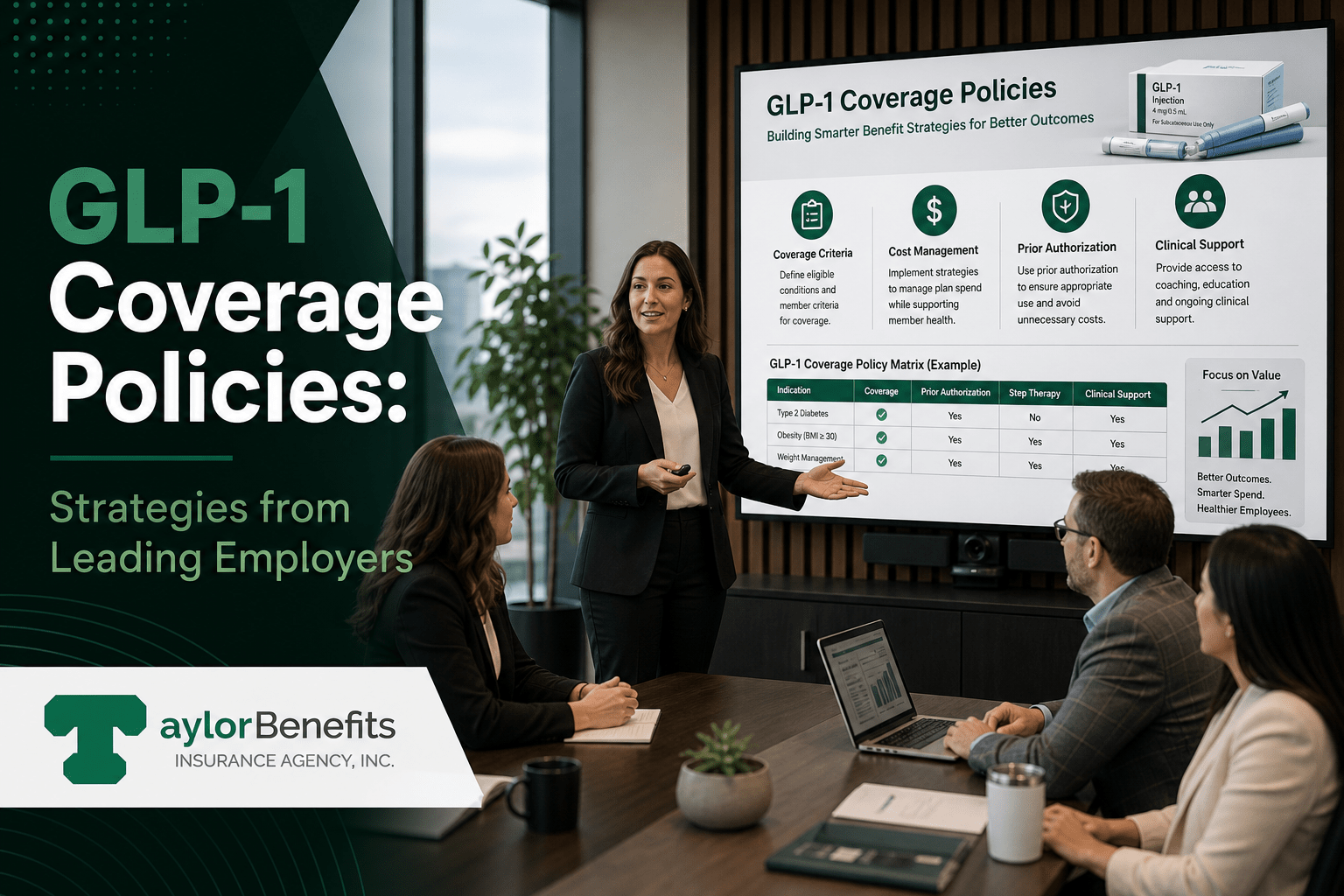
Three years into the GLP-1 era, the conversation among benefits leaders has shifted from “should we cover these drugs” to “how do we structure coverage policies that work — clinically, financially, and for the employees who need access.” The shift reflects a market reality: GLP-1 medications for weight loss and diabetes are no longer a hypothetical pharmacy consideration. They are the single fastest-growing line item in employer pharmacy spend for most plans, with annual per-member costs frequently exceeding $10,000 to $15,000 for members on therapy and prevalence growing across virtually every workforce demographic.
The early employer responses to GLP-1 demand fell into two extremes that produced predictable problems. Some employers covered the drugs broadly with minimal utilization management — and absorbed pharmacy budget impacts that materially exceeded projections, often forcing mid-year corrective action. Others excluded GLP-1 weight loss coverage entirely — and faced employee dissatisfaction, recruitment challenges, and growing pressure as cultural and clinical norms around the drugs evolved.
The leading employer response in 2026 lives between these extremes: structured coverage policies that combine eligibility criteria, utilization management, lifestyle program integration, and budget controls in ways designed to deliver real clinical value while keeping costs sustainable. This article walks through what those policies actually look like, what’s working, and what employers can learn from the pattern of practices emerging across the market.
Before discussing policy responses, it helps to be precise about the cost dynamics employers are managing. GLP-1 medications include drugs originally approved for type 2 diabetes (Ozempic, Mounjaro, Trulicity) and drugs approved specifically for weight loss (Wegovy, Zepbound, Saxenda). Several of the diabetes-approved drugs are also widely used off-label for weight loss, complicating the clinical distinction.
The cost dynamics that have made GLP-1s a defining pharmacy budget challenge include:
List prices in the $1,000+ per month range. Wegovy, Zepbound, and the diabetes drugs commonly used off-label for weight loss carry list prices that translate to net annual costs to employer plans of $8,000 to $14,000+ per member on therapy after typical rebates and discounts.
Sustained therapy duration. Unlike many high-cost drug categories where therapy is time-limited, GLP-1 medications are typically prescribed as ongoing chronic therapy. Members who start on the drugs and respond clinically often continue for years, with cost compounding over time.
High prevalence in the eligible population. The clinical eligibility criteria for FDA-approved weight loss indications (BMI ≥ 30, or ≥ 27 with weight-related comorbidities) describe a substantial percentage of the U.S. adult population. Employer plans that cover GLP-1 weight loss medications without additional eligibility constraints can see utilization rates that translate into pharmacy budget impacts of 15 to 25 percent or more of total pharmacy spend.
Adherence challenges and side effects. A significant percentage of patients who initiate GLP-1 therapy discontinue within the first six to twelve months due to side effects, cost barriers, or lack of perceived benefit. The plans that pay for initiated-but-discontinued therapy capture limited clinical value relative to the spend.
The compounded version landscape. Compounded GLP-1 medications — produced by compounding pharmacies under FDA shortage rules — have created a parallel market that affects both costs and clinical safety considerations, with regulatory uncertainty about how long this market will operate.
These dynamics create a coverage decision that doesn’t have an easy answer. Excluding coverage entirely is increasingly difficult to defend on employee experience and clinical equity grounds. Covering broadly without controls produces unsustainable budget impacts. The middle path requires deliberate policy design.
Employer GLP-1 coverage policies in 2026 cluster into several recognizable approaches, each with distinct tradeoffs.
The most restrictive widely-adopted approach covers GLP-1 medications only for FDA-approved type 2 diabetes indications and excludes coverage for weight loss indications, including off-label use of diabetes-approved GLP-1s for weight management.
How it’s structured:
What it costs: This approach minimizes incremental cost beyond what the plan was already paying for diabetes medications, but it does increase costs for diabetes treatment itself as GLP-1 prescribing for diabetes has expanded substantially.
What it delivers: Cost predictability and minimal pharmacy budget disruption, but no employee access to GLP-1s for weight management. This produces meaningful employee dissatisfaction in workforces where GLP-1 awareness is high and excludes the cardiovascular and metabolic benefits these drugs deliver beyond weight loss.
Where it fits: Employers with severe pharmacy budget constraints, employers in industries where weight management benefits are not a priority component of the benefits package, and employers transitioning from no GLP-1 coverage to staged expansion.
A more inclusive approach that covers FDA-approved weight loss GLP-1s for members meeting strict eligibility criteria — typically BMI ≥ 35 or ≥ 30 with weight-related comorbidities — combined with utilization management to confirm ongoing clinical benefit.
How it’s structured:
What it costs: Materially higher than diabetes-only coverage but significantly lower than unrestricted weight loss coverage. Typical pharmacy budget impact runs 5 to 12 percent of total pharmacy spend, depending on workforce demographics and clinical eligibility prevalence.
What it delivers: Clinically credible coverage for members with the highest medical need, structured to support sustained engagement with weight management rather than episodic drug therapy. This approach has the strongest clinical defensibility and the most defensible long-term economics.
Where it fits: Most mid-market and large self-funded employers seeking a middle path between exclusion and unrestricted coverage. This is the most common structure among employers who have implemented thoughtful GLP-1 policies.

A more accessible approach that covers GLP-1 weight loss medications for members meeting basic FDA-approved eligibility criteria (BMI ≥ 30, or ≥ 27 with comorbidities) but requires concurrent participation in an integrated lifestyle management program.
How it’s structured:
What it costs: Higher than Approach 2, with pharmacy budget impact typically running 10 to 18 percent of total pharmacy spend. The lifestyle program component itself adds modest cost but is intended to improve long-term outcomes and reduce drug discontinuation.
What it delivers: Broader employee access combined with structural support for sustained weight management. The clinical evidence for whether mandatory lifestyle program integration meaningfully improves outcomes is mixed but growing, and employers using this approach generally report higher member engagement than approaches without integration.
Where it fits: Employers prioritizing employee access and engagement in weight management benefits, employers with workforces where GLP-1 access is a meaningful recruitment and retention factor, and employers with the budget capacity to absorb broader coverage costs.
A less common approach that maintains broad eligibility but uses member cost-sharing structures to influence utilization decisions and capture some cost recovery from members.
How it’s structured:
What it costs: Variable based on member cost-sharing levels. Plans with higher member cost-sharing capture meaningful cost recovery but may face equity concerns about access and adherence among lower-wage employees.
What it delivers: Broader access with budget impact partially offset by member cost-sharing. The approach raises questions about whether it effectively rations access by income — a concern that has generated significant employer attention as workforce equity considerations have become more central to benefits design.
Where it fits: Employers prioritizing maximum employee access while managing budget impact through member cost-sharing rather than through eligibility restriction. Less commonly the leading approach among large self-funded employers in 2026, as equity considerations have shifted leading practice toward Approach 2 or 3.
Some employers continue to exclude GLP-1 weight loss coverage entirely, while maintaining standard diabetes coverage. This was a more common position in 2023 and 2024 but is becoming less defensible in 2026 as clinical evidence for cardiovascular and metabolic benefits has expanded and employee expectations have shifted.
Employers maintaining total exclusion are increasingly under pressure from clinical advocacy, employee dissatisfaction, and competitive recruitment dynamics — particularly in industries and labor markets where GLP-1 access is a recognized component of competitive benefits.

The employers who report the most positive outcomes from GLP-1 coverage policies — measured in clinical engagement, member satisfaction, sustainable cost trajectories, and absence of mid-year policy reversal — generally share several practice patterns.
Initial authorization is one decision. Continuation authorization — every 3, 6, or 12 months — is where utilization management actually controls cost. Plans that approve initial authorization broadly but require documented clinical progress for continuation maintain better long-term economics than plans that approve initial therapy and continue authorizations indefinitely.
Typical continuation criteria include documented minimum weight loss percentages within defined timeframes (often 5 percent at three months, 10 percent at six to twelve months), continued program participation where applicable, and clinical confirmation that side effects are tolerable and benefits are sustained. Members not meeting continuation criteria may be transitioned off GLP-1 therapy or moved to alternative weight management approaches.
Employers who structure GLP-1 coverage as part of an integrated weight management program — combining drug therapy with lifestyle coaching, nutritional support, and behavioral health resources — generally report better member outcomes and more sustainable cost trajectories than employers who cover the drugs without integrated programming. The integration may take various forms (carrier-sponsored programs, dedicated weight management vendors, EAP integration) but the principle is consistent: GLP-1s as a component of weight management rather than as standalone drug therapy.
Members receiving GLP-1 coverage benefit from clear communication on what the plan is offering, what the clinical pathway looks like, what the continuation criteria are, and what the program expectations are. Plans that communicate this proactively at the point of authorization generate better member engagement and fewer disputes than plans that surface continuation criteria only when members are denied refills.
The execution of GLP-1 coverage policy depends substantially on PBM utilization management capabilities. Plans with PBM partners who have implemented robust GLP-1-specific utilization management — including BMI verification, comorbidity documentation, continuation criteria enforcement, and lifestyle program coordination — execute their policies far more effectively than plans where the PBM provides only basic prior authorization.
For employers reviewing PBM contracts in 2026, GLP-1 utilization management capability is a meaningful evaluation criterion. PBMs vary substantially in their GLP-1 program sophistication.
The ability to capture savings from any utilization management approach is mediated by the pharmacy plan funding structure. Self-funded employers with transparent PBM contracts capture the full economic benefit of utilization management directly. Self-funded employers with traditional rebate-retention PBM contracts capture less of the savings, because rebate dynamics on GLP-1s tied to ongoing therapy can partially offset the savings from reduced authorization volume.
This is part of the broader pharmacy strategy conversation that connects GLP-1 policy to PBM contract structure, biosimilar strategy, and overall pharmacy management — all topics that interact substantially in determining what employer plans actually pay for specialty drug spend.

The employers reporting the most significant problems with GLP-1 coverage policies typically exhibit one or more of the following patterns.
Coverage policies designed without utilization management infrastructure. Employers who announce coverage policies without ensuring their PBM can actually execute the prior authorization, continuation criteria, and program integration components find that their policies operate in name only. Members receive authorization based on minimal review, continuation criteria are not enforced, and costs run materially above projections.
Mid-year policy reversal. Employers who cover GLP-1s broadly for initial plan years and then attempt to introduce restrictions mid-year or at renewal in response to budget impact face significant employee dissatisfaction and clinical disruption. Members who established therapy under one set of rules and then face changed coverage report feelings of betrayal that affect broader benefits perception.
Policies that are too restrictive for the workforce demographic. Employers with workforces where GLP-1 awareness and demand are high — particularly those competing for talent in markets where competitor plans offer GLP-1 access — face recruitment and retention pressure when their policies are substantially more restrictive than market norms. Total exclusion in particular has become a competitive disadvantage in many markets.
Policies without clear communication infrastructure. Coverage decisions communicated only through formulary listings or denial letters generate confusion and dispute volume that consumes HR and benefits administration time. Proactive communication on coverage policies, eligibility criteria, and the clinical pathway reduces this overhead substantially.
No financial modeling at decision points. Employers who adopt coverage policies without modeling expected utilization and budget impact frequently find that actual experience diverges materially from informal expectations. Formal modeling — even with significant uncertainty ranges — provides a baseline for monitoring whether coverage policy is performing as expected and a trigger for adjustment when it isn’t.
For employers establishing or revising GLP-1 coverage policies for 2026, the following sequence reflects the patterns of successful implementation.
Step 1: Audit current GLP-1 spend and utilization in your plan. Identify what your plan is actually paying for GLP-1 therapy across diabetes and weight loss indications, what your member utilization rates are, and how those compare to industry benchmarks for your workforce demographics.
Step 2: Engage your PBM on utilization management capabilities. Confirm what GLP-1-specific utilization management your PBM offers, including BMI verification, comorbidity documentation, continuation criteria enforcement, and program integration capabilities.
Step 3: Evaluate available lifestyle and weight management program options. Identify whether your carrier or TPA offers integrated weight management programs, whether dedicated weight management vendors fit your situation, or whether existing wellness program infrastructure can support GLP-1 coverage integration.
Step 4: Model the financial impact of coverage policy alternatives. Run financial models for the coverage approaches under consideration, with realistic assumptions for utilization rates, continuation rates, and cost trajectories. Use these models to confirm that the coverage approach you select is sustainable given your pharmacy budget capacity.
Step 5: Communicate policy clearly to members. Whatever coverage approach you adopt, communicate it proactively, with clear explanation of eligibility criteria, the clinical pathway, continuation requirements, and any program integration expectations. Reactive communication only at the point of denial generates substantially more dispute volume and member dissatisfaction.
Step 6: Monitor performance and be prepared to adjust. GLP-1 coverage policies are not set-and-forget decisions. Monitor utilization, costs, clinical outcomes, and member feedback at regular intervals, and be prepared to refine the policy as data accumulates. The goal is sustainable long-term policy, not a one-time decision.

GLP-1 coverage policy is one of the defining pharmacy benefits decisions of the current era, and the gap between well-designed and poorly-designed coverage policies translates into millions of dollars of variance in employer pharmacy spend along with substantial differences in member experience and clinical outcomes.
The employers getting it right in 2026 are not the ones with the most restrictive policies or the most generous policies — they are the ones with the most deliberately structured policies. Strict continuation criteria, integrated lifestyle program participation, robust PBM utilization management, clear member communication, and ongoing performance monitoring collectively distinguish the successful implementations from the troubled ones.
For employers with GLP-1 policies that were established quickly in 2023 or 2024 and have not been substantively reviewed since, 2026 is an appropriate time for a structured review. The market has matured, the policy options have clarified, and the patterns of what works versus what doesn’t are increasingly visible.
Taylor Benefits Insurance Agency works with self-funded and level-funded employers on pharmacy strategy, including GLP-1 coverage policy design, PBM utilization management evaluation, and integrated weight management program selection. If you’re reviewing your GLP-1 approach for 2026 — or implementing coverage policy for the first time — contact our team for a consultation.
Most insurance plans require proof that you tried other weight loss methods first. This can include diet programs, exercise plans, or older medications. Insurers want documented evidence that these approaches did not work well enough. Without this step, prior authorization is often denied. Your doctor usually needs to provide records showing your past attempts before approval is considered.
Coverage often depends on the health plan, medical necessity, approved conditions, and prior authorization requirements. Employers can review policy details to understand how these medications are included in their benefits.

Todd Taylor oversees most of the marketing and client administration for the agency with help of an incredible team. Todd is a seasoned benefits insurance broker with over 35 years of industry experience. As the Founder and CEO of Taylor Benefits Insurance Agency, Inc., he provides strategic consultations and high-quality support to ensure his clients’ competitive position in the market.

We just started working with Taylor Benefits and could not be happier. Todd gave us quite the education as well as some time saving tools to help us manage our HR and save money too. We are looking forward to a long relationship!”
-Carol, Accounting Manager, recruitment marketing company, Campbell, CA
We’re ready to help! Call today: 800-903-6066