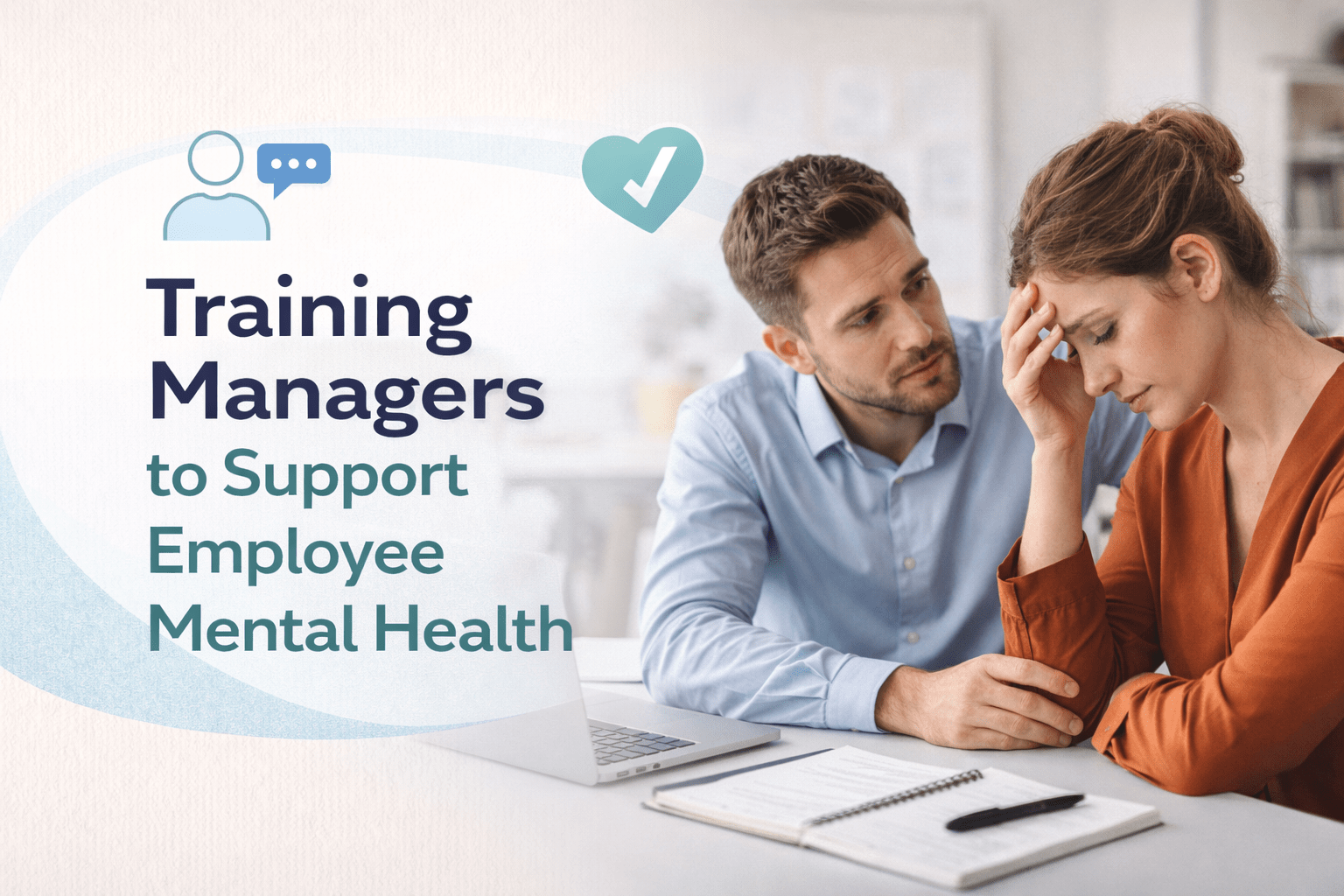
Training Managers to Support Employee Mental Health
By Todd Taylor
|
Last updated: August 13, 2026
Mental health benefits have expanded rapidly in employer-sponsored health plans, but benefits alone do not determine outcomes. In many organizations, the frontline determinant of whether employees feel supported, or silenced, is their direct manager. In 2026, employers are increasingly recognizing that manager training is one of the most important and overlooked components of an effective mental health strategy.
Managers are not clinicians, and they should not be expected to diagnose or treat mental health conditions. However, they do shape daily work experiences, set expectations, and serve as the first point of contact when employees struggle. Without proper training, even well-intentioned managers can inadvertently worsen stress, mishandle sensitive conversations, or create compliance risk.
This article explores why manager training matters, what effective training looks like, and how employers can implement programs that support employee mental health while protecting the organization.
Why Managers Play a Central Role in Mental Health Outcomes
Employees interact with their managers more frequently than with HR, benefits teams, or executive leadership. As a result, managers have outsized influence over workload, flexibility, psychological safety, and communication norms.
When employees experience stress, burnout, or mental health challenges, they often hesitate to approach HR directly. Instead, they may signal distress through changes in behavior, performance, or engagement. Managers who are trained to recognize these signals can respond early and appropriately.
Conversely, managers who lack awareness or confidence may dismiss concerns, overreact, or avoid the issue entirely—each of which can escalate problems.
The Risks of Untrained Managers
Failing to train managers on mental health carries real risks. Missteps in conversations about mental health can lead to employee disengagement, formal complaints, or legal exposure.
Managers who attempt to “solve” mental health issues may unintentionally cross boundaries, while those who ignore concerns may be perceived as unsupportive or discriminatory. Inconsistent responses across teams can also create perceptions of inequity.
From a compliance perspective, mishandled mental health conversations can implicate disability accommodation laws, leave requirements, and privacy obligations. Training helps managers navigate these complexities responsibly.
Shifting the Manager Mindset From Fixer to Supporter
One of the most important goals of manager mental health training is redefining the manager’s role. Managers do not need to fix mental health issues—they need to support employees and connect them to appropriate resources.
This shift reduces pressure on managers while clarifying expectations. Training should emphasize listening, empathy, and referral rather than problem-solving or judgment.
When managers understand their role clearly, they are more likely to engage confidently and appropriately.
Recognizing Early Warning Signs Without Diagnosing
Effective training helps managers recognize changes in behavior that may indicate distress without encouraging diagnosis or speculation. These signs may include changes in attendance, productivity, communication patterns, or interpersonal interactions.
The focus is not on identifying specific conditions, but on noticing when something is different and initiating a supportive conversation. Managers should be taught to approach these conversations with curiosity and concern rather than assumptions.
This approach respects employee privacy while enabling early support.
How to Have Supportive, Compliant Conversations
Managers often avoid mental health conversations because they fear saying the wrong thing. Training can provide practical frameworks and language that help managers engage confidently.
Key elements of effective conversations include expressing concern, listening without judgment, and offering support options. Managers should also understand what questions to avoid, particularly those that could be perceived as invasive or discriminatory.
Clear guidance on documentation and escalation ensures consistency and protects both employees and the organization.
Connecting Employees to Resources
A critical component of manager training is ensuring managers know what resources are available and how to refer employees appropriately. This includes understanding mental health benefits, employee assistance programs, leave options, and workplace accommodations.
Managers do not need to be experts in benefits administration, but they should know where to direct employees for support. Quick, confident referrals increase the likelihood that employees will seek help.
Training should also reinforce that referrals are supportive, not punitive.
Supporting Flexibility and Work Adjustments
In many cases, temporary flexibility or workload adjustments can significantly reduce stress and support recovery. Managers play a key role in implementing these adjustments within organizational guidelines.
Training should clarify what types of flexibility are available, when HR involvement is required, and how to ensure fairness across teams. Managers should also understand how to balance individual needs with operational requirements.
When handled thoughtfully, flexibility benefits both employees and employers.
Managing Performance While Supporting Mental Health
One of the most challenging aspects of mental health support is balancing compassion with performance expectations. Managers may worry that acknowledging mental health issues means lowering standards or avoiding accountability.
Training can help managers navigate this tension by separating performance management from health support. Clear expectations, regular feedback, and documented processes help ensure fairness and clarity.
Supporting mental health does not mean ignoring performance—it means addressing both in a structured, humane way.
Legal and Compliance Considerations
Manager training must incorporate legal context. Mental health conditions may qualify as disabilities, triggering accommodation and leave obligations. Managers should understand when to involve HR and how to avoid making unilateral decisions that create risk.
Training should also address confidentiality. Managers must know what information can be shared, with whom, and under what circumstances.
By embedding compliance awareness into training, employers reduce the likelihood of costly mistakes.
Creating Psychological Safety Through Leadership Behavior
Beyond formal training, manager behavior shapes workplace culture. Employees are more likely to seek help when managers model openness, respect boundaries, and demonstrate empathy.
Training programs that include self-awareness and leadership development can reinforce these behaviors. When leaders normalize conversations about wellbeing, stigma decreases and engagement increases.
Psychological safety is not created by policies alone—it is built through daily interactions.
Measuring the Impact of Manager Training
Employers should evaluate the effectiveness of manager mental health training through multiple lenses. Participation rates, manager confidence surveys, and employee engagement data provide valuable insight.
Over time, organizations may also see changes in absenteeism, turnover, and disability claims. While these outcomes are influenced by many factors, improved manager capability often plays a meaningful role.
Continuous improvement ensures training remains relevant and effective.
Scaling Training Across the Organization
In 2026, many employers are moving beyond one-time training sessions toward ongoing education. This may include refresher courses, role-based training, and integration into leadership development programs.
Scaling training ensures consistency across teams and reinforces expectations. It also signals that mental health support is a sustained priority rather than a temporary initiative.
Integrating Manager Training Into a Broader Mental Health Strategy
Manager training is most effective when integrated with broader mental health initiatives. Benefits, policies, and workplace practices should align to create a cohesive support system.
When managers understand how their role fits into the larger strategy, they are better equipped to support employees and reinforce organizational values.
Integration also improves utilization of mental health benefits by reducing fear and confusion.
How Taylor Benefits Helps Employers Build Manager Capability
At Taylor Benefits Insurance Agency, we help employers strengthen mental health strategies by focusing on both benefits design and leadership capability.
Our team works with organizations to align mental health benefits, manager training, and compliance requirements. We help employers identify gaps, select appropriate training solutions, and integrate manager education into broader wellbeing initiatives.
As mental health continues to shape workforce outcomes in 2026 and beyond, empowering managers is essential. If your organization is looking to equip leaders to support employee mental health effectively and responsibly, our advisors are here to help you build a program that delivers real results.
Frequently Asked Questions
Training normalizes discussions about mental health, teaches managers to respond empathetically, and encourages a culture where seeking help is seen as responsible rather than a weakness.
When managers understand how to support mental wellbeing, employees often feel safer and more valued. This reduces stress-related absences and improves communication. Over time, teams become more stable, focused, and engaged, which naturally leads to better productivity and workplace morale.
Employees have different experiences and challenges that may affect their wellbeing. Training helps managers respond fairly, avoid bias, and create an environment where everyone feels respected and valued.
Written by Todd Taylor
Todd Taylor oversees most of the marketing and client administration for the agency with help of an incredible team. Todd is a seasoned benefits insurance broker with over 35 years of industry experience. As the Founder and CEO of Taylor Benefits Insurance Agency, Inc., he provides strategic consultations and high-quality support to ensure his clients’ competitive position in the market.
We just started working with Taylor Benefits and could not be happier. Todd gave us quite the education as well as some time saving tools to help us manage our HR and save money too. We are looking forward to a long relationship!”
-Carol,Accounting Manager, recruitment marketing company, Campbell, CA