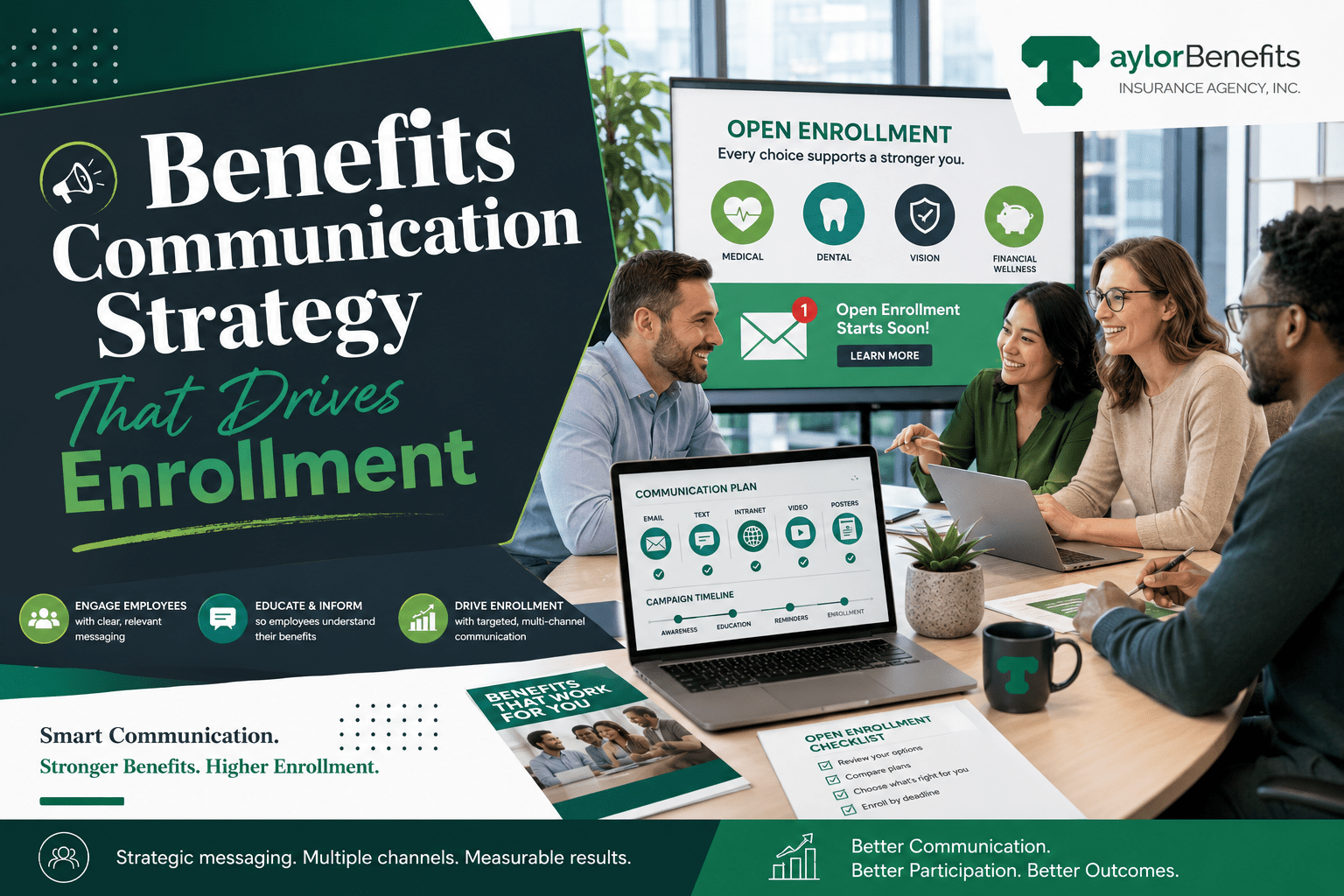
How to Build a Benefits Communication Strategy That Actually Gets Employees to Enroll

By Todd Taylor  |  Last updated: May 14, 2026

Most open enrollment communication strategies are built on a flawed assumption: that distributing benefits information is the same as communicating benefits value. The two are not equivalent, and the gap between them produces the most common failure modes in employer benefits programs — passive default elections, low voluntary benefits participation, employees who don’t understand their plan choices, and HR teams overwhelmed with questions the communication itself should have answered.

The employers who consistently achieve high enrollment quality — measured in informed plan selection, meaningful voluntary benefits participation, and employee satisfaction — operate communication strategies that look fundamentally different from the standard annual email-and-PDF approach. They treat communication as a structured, multi-channel, year-round discipline rather than an annual event. They design materials around how employees actually engage with information rather than how HR finds it convenient to distribute. And they measure communication effectiveness with the same rigor they apply to other benefits performance metrics.

This article covers what those strategies look like, what makes them work, and how employers can build a communication discipline that produces better enrollment outcomes year after year.

Why Standard Benefits Communication Fails

The standard benefits communication pattern at most employers includes some combination of:

  • A benefits guide PDF distributed by email
  • One or two open enrollment information sessions (often virtual, often poorly attended)
  • A reminder email near the enrollment deadline
  • Posted materials on the company intranet or benefits portal
  • Whatever direct support HR can provide in response to inbound questions

This pattern produces predictable failures. Email-based distribution reaches a fraction of the workforce that actually opens and reads the content. Live sessions reach a smaller fraction. PDF benefits guides are designed for completeness rather than comprehension — they answer questions employees might have but rarely surface the information that would change how employees evaluate their elections.

The deeper problem is conceptual. Standard communication treats employees as rational actors who will gather information, weigh tradeoffs, and make optimal decisions if given comprehensive materials. Actual employee decision-making looks very different: most employees spend minimal time on benefits decisions, default to their prior elections, and engage with materials only when prompted by specific friction in the enrollment process.

Communication strategies built around the rational-actor model fail to reach the population that needs them most — employees not actively engaged with benefits decisions, who will default to whatever path of least resistance the system presents.

employee benefit packages Johns Creek GA, employee benefit plans Johns Creek GA, employee benefits Johns Creek GA

The Principles That Distinguish Effective Communication

Strong benefits communication strategies share several principles that the standard approach lacks.

  • Multi-channel delivery. No single communication channel reaches the full workforce. Effective strategies combine email, mobile app notifications, video content, in-person and virtual sessions, manager-led conversations, and direct mail or physical materials. Each channel reaches a different audience subset, and combining them increases total reach substantially.
  • Year-round engagement rather than annual events. Treating benefits communication as a once-a-year activity tied to open enrollment limits engagement to that narrow window. Strong strategies maintain benefits awareness throughout the year — at hiring, at life events, during seasonal moments when specific benefits are relevant, and in response to news and external context that affects how employees evaluate their coverage.
  • Personalization based on employee context. Communication that speaks to a single employee’s actual situation — their current elections, their life stage, their family composition — is materially more effective than generic communication designed for the average employee. Modern benefits administration platforms increasingly support personalization at scale; older approaches typically don’t.
  • Plain language and visual design. The benefits industry’s default communication style — built around insurance industry terminology, dense text, and complex tables — is functionally inaccessible to most employees. Strong communication translates insurance language into plain English, uses visual design to make information scannable, and prioritizes comprehension over technical precision.
  • Active decision support rather than passive information distribution. Effective communication helps employees make decisions rather than just providing information they could use to make decisions. Decision-support tools, comparison frameworks, scenario examples, and direct guidance materially change enrollment outcomes compared to information-only approaches.

Building the Communication Plan: A Practical Framework

For employers building or rebuilding a benefits communication strategy, the following framework provides a structured starting point.

Define the Audience Segments

Different employee populations need different communication approaches. The relevant segments typically include:

  • New hires entering the benefits program for the first time
  • Existing employees during open enrollment making annual decisions
  • Employees experiencing life events with mid-year enrollment opportunities
  • Specific demographic or workforce segments with distinct needs (hourly workers, remote workers, multi-language populations, employees nearing retirement)
  • Year-round audiences receiving general benefits engagement and education

A communication plan that treats all of these as a single undifferentiated audience will under-serve the segments with the most specific needs.

Map the Communication Calendar

Strong communication strategies operate on a structured calendar that spans the full year rather than concentrating activity in the open enrollment window. A typical calendar includes:

  • Pre-open enrollment (60 days out): Awareness building, benefits highlight reels, decision-support tool launches
  • Open enrollment window: Active communication daily or every other day, with escalating urgency as the deadline approaches
  • Immediately post-enrollment: Confirmation, ID card distribution, plan-use orientation
  • Q1 of the new plan year: Benefits utilization education focused on actually using elected coverage
  • Mid-year: Topic-specific deep dives, life event reminders, voluntary benefits engagement
  • Late-year pre-renewal preparation: Education about upcoming changes, plan design previews

The calendar should be documented, owned by a specific person, and reviewed annually for effectiveness.

Select the Channel Mix

The right channel mix depends on workforce composition. For most mid-market employers, an effective mix includes:

  • Email for primary distribution to office and remote workers
  • Mobile app notifications for reaching workers who don’t regularly check email
  • Video content for explaining complex topics
  • Live or recorded webinars for interactive Q&A
  • In-person sessions for workforces with physical work locations
  • Manager-led conversations for high-stakes topics that benefit from individual context
  • Direct mail or physical materials for hard-to-reach segments
  • Text messaging for time-sensitive reminders during enrollment windows

Each channel should be evaluated on actual reach and effectiveness for the specific workforce, not on convenience to HR.

Design Materials for Comprehension

The materials themselves need to be built for employee comprehension rather than for HR-side completeness. Practical design principles:

  • Lead with the question employees are asking, not with the technical structure of the plan
  • Use visual comparison tools for plan choices (side-by-side tables with cost and key features)
  • Show real scenarios illustrating how different plan choices play out for different employee situations
  • Translate insurance language into terms employees use (“how much you pay before insurance kicks in” rather than “annual deductible”)
  • Provide decision frameworks that guide employees through plan selection logic
  • Make materials skimmable with clear headers, callout boxes, and visual hierarchy

A thriving business in O’Fallon, Missouri, goes beyond offering competitive salaries. To attract and retain top talent, a comprehensive employee benefits package is crucial. This not only sets your business apart from competitors but also ensures the well-being and satisfaction of your workforce. In this blog post, we will guide you through the importance of employee benefit packages O’Fallon MO, health insurance options, customizing benefits, and local resources to help you build the best package for your O’Fallon business. Key Takeaways Employee benefits packages are essential for businesses in O’Fallon, MO to attract and retain top talent. Insurance brokers provide expert advice on employee benefit packages tailored to a business’s unique needs. Successful companies create comprehensive and competitive employee benefits by setting goals, obtaining input from employees, designing options with flexibility, communicating effectively & conducting regular reviews/updates. The Importance of Employee Benefit Packages in O'Fallon MO In the fiercely competitive business landscape, a comprehensive employee benefits insurance package serves as a significant draw for skilled and motivated employees. Some examples of the benefits that can make your company more appealing to top talent in O’Fallon, MO include: Generous paid time off Health insurance Dental and vision coverage Tuition reimbursement Consequently, employee benefits and salary can significantly impact the success rate of your hiring initiatives and contribute to the overall business growth. The City of O’Fallon, the largest municipality by population in Saint Charles County, offers a variety of benefits to its employees, including: Insurance Health and wellness programs Financial and retirement benefits Family and parenting benefits As the average base salary for an Employee Benefits Programs Analyst I in O’Fallon is $61,200, it’s clear that businesses in the city are investing in employee benefits to stay competitive and attract the best talent. Navigating Health Insurance Options in O'Fallon MO While sifting through health insurance options can be daunting, gaining insights into the variety of plans available for O’Fallon, MO businesses can help craft a standout competitive job offer. The succeeding sections will delve into group health insurance plans and ACA compliant policies that pave the way for optimal health coverage for your employees. Group Health Insurance Plans Group health insurance plans are designed to provide coverage for a group of people, typically employees of a particular company. In O’Fallon, MO, businesses have access to a range of group health insurance plans, such as Preferred Provider Organization (PPO) plans, Health Maintenance Organization (HMO) plans, and High Deductible Health Plans (HDHP) with Health Savings Accounts (HSA). These plans offer several benefits, including cost savings, comprehensive coverage, employer contribution, access to a network of healthcare providers, health and wellness programs, and continuity of coverage. Establishing a group health insurance plan for your O’Fallon business involves several steps: Researching insurance providers Scrutinizing plans and coverage Liaising with providers Setting up the plan Enrolling employees Circulating information throughout your workforce A well-structured group health insurance plan is key to drawing top talent and fostering a healthy, productive work environment, making it essential for companies to prioritize when creating jobs. ACA Compliant Policies The Affordable Care Act (ACA) is a federal law that has significant implications for businesses in O’Fallon, MO. ACA compliance requires employers to pay for: Provide compliant health insurance coverage to their employees Ensure the coverage is both affordable and meets minimum value requirements Offer minimum essential coverage to 95% of full-time employees and their dependents Failing to meet these requirements can result in a penalty of $2,970 per employee. Adherence to ACA compliant policies allows O’Fallon businesses to reap numerous benefits, such as: A broader selection of health insurance plans Safeguards against pre-existing condition exclusions Cost-sharing free preventive care services coverage Prohibition of annual and lifetime benefit limits Access to essential health benefits coverage Compliance with federal regulations to avoid penalties Guaranteeing ACA compliance is a cornerstone of offering optimal employee benefits insurance package. Customizing Employee Benefits for Your O'Fallon Business Beyond health insurance, a myriad of other employee benefits can be customized to meet your O’Fallon business’s unique needs. The upcoming sections will explore retirement and savings plans, family and parenting benefits, and wellness programs, all of which contribute to a comprehensive, competitive employee benefits package. Retirement and Savings Plans Retirement and savings plans are instrumental in bolstering the long-term financial security of your O’Fallon, MO employees. Businesses can choose from a variety of options, such as: Business planning Corporate retirement plan consulting Education planning Estate planning Charitable giving Furthermore, the Missouri Workplace Retirement Savings Plan is a voluntary, open, multiple-employer plan tailored for small employers. To establish a 401(k) program for your employees, you must meet certain requirements, such as: Eligibility for retirement plan tax credits An auto-enrollment option An initial automatic employee contribution of at least 3% of compensation The potential for automatic contribution increases By offering a well-structured retirement and savings plan, you can support your employees’ long-term financial goals and demonstrate your commitment to their well-being. Family and Parenting Benefits Family and parenting benefits significantly boost employee satisfaction and foster a healthy work-life balance in O’Fallon. Offering flexible work schedules, parental leave, childcare assistance, and family-friendly policies can ease the burden on employees as they juggle work and family responsibilities. In O’Fallon, MO, employees have access to a range of family and parenting benefits, including: Medical plans Vision Dental Life coverage Parental leave Family and medical leave (FMLA) Implementing family and parenting benefits can: Cultivate a supportive work environment Foster employee engagement, productivity, and loyalty Contribute to a better work-life balance Reduce stress Lower turnover rates Ultimately, these benefits can contribute to your business’s overall success. Wellness Programs Wellness programs are initiatives that aim to promote a healthy workforce and enhance productivity in O’Fallon businesses. A comprehensive wellness program should include: Assessment Strategy Implementation Evaluation Health education Supportive social and physical environment Incorporation of wellness into company culture Tools and resources targeting diverse areas of wellness Options that easily fit into an employee’s day Offering wellness programs like corporate fitness programs and wellness initiatives from local fitness centers like Louis Fitness Factory can help your business curtail absenteeism, boost productivity, and manage healthcare costs. Providing professional nutrition and fitness advice, tailored medical services, and access to wellness resources demonstrates your commitment to the well-being and overall health of your employees in O’Fallon, MO. The Role of Insurance Brokers and Agents in O'Fallon MO Insurance brokers and agents are indispensable in assisting O’Fallon businesses in finding suitable employee benefits packages. Brokers serve as liaisons between insurance companies and customers, offering expert advice and direction, while agents act on behalf of insurance companies. Both brokers and agents: Evaluate the insurance requirements of their customers Explore the market for the most advantageous policies and rates Facilitate claims processing Offer ongoing support and advice to guarantee that clients have the appropriate coverage for their individual needs. In O’Fallon, MO, insurance agents can provide invaluable assistance to businesses in selecting employee benefit packages. They can help by: Evaluating the requirements of the business and its employees Assessing available options Recommending suitable benefit packages that align with the company’s budget and objectives Their expertise and familiarity with the insurance market and regulations enable businesses to make informed decisions and successfully manage the complexities of employee benefits. Legal Requirements and Compliance for O'Fallon Employers O’Fallon employers must comprehend and abide by legal requirements and compliance considerations when offering employee benefits. Regulations and policies can be found in the O’Fallon employee handbook and personnel code, as well as on the official website of the City of O’Fallon. Participating in the Missouri Workplace Retirement Savings Plan MEP is also an option for employers with 50 or fewer employees. Failure to comply with O’Fallon MO employee benefits laws may result in fines and other penalties. Meeting all legal requirements and adhering to local and federal regulations is key to maintaining a successful employee benefits program and steering your employer clear of potential legal issues. Best Practices for Communicating Employee Benefits Effective communication of employee benefits is vital to keeping employees informed about their options and enabling them to make conscious decisions about their coverage. Here are some recommended strategies for successfully conveying complex employee benefits information to your workforce: Clear and engaging communication Personalization Utilization of multiple communication channels Simplification of complex information Ongoing communication Feedback solicitation By implementing these strategies, you can ensure that your employees have a clear understanding of their benefits and are able to make informed decisions. Some examples of effective employee benefits communication in O’Fallon, MO, include addressing the needs and goals of employees, raising employee knowledge, and increasing the return on investment for employers’ benefits packages. Implementing these best practices can aid your employees in fully understanding and valuing their benefits package, consequently enhancing their satisfaction and loyalty to your business. Local Resources and Support for O'Fallon Businesses A wealth of local resources and support is available for O’Fallon businesses seeking guidance on employee benefit packages. Some of these resources include: St. Charles County Community Resources ADP VolunteerMatch PeopleKeep These organizations can provide valuable information and assistance for businesses creating employee benefit packages. Local government resources, such as the O’Fallon Human Resources department and the St. Charles County government website, are also available for review and consultation regarding employee benefit packages. Leveraging these local resources and support can help your O’Fallon business maintain competitiveness and offer an optimal employee benefits package to your workforce. Case Studies: Successful Employee Benefit Packages in O'Fallon MO Businesses in O’Fallon, MO have successfully implemented employee benefits packages by following these strategies: Setting goals Devising a budget Obtaining employee input Carrying out needs assessments Designing benefit options Offering flexibility Communicating effectively Conducting regular reviews and updates of their offerings By following these strategies, your O’Fallon business can create a comprehensive and competitive employee benefits package that meets the needs of your workforce and contributes to the success of your company. Health insurance, retirement plans, paid time off, and wellness programs are just a few examples of benefits typically included in successful employee benefit packages in O’Fallon, MO. By offering a well-rounded package that caters to the diverse needs of your employees, your business can demonstrate its commitment to employee well-being and job satisfaction, ultimately leading to a happier, healthier, and more productive workforce. Summary In conclusion, offering a comprehensive and competitive employee benefits package is essential for attracting and retaining top talent in O’Fallon, MO. By understanding health insurance options, customizing your benefits to suit your business’s unique needs, and leveraging local resources and support, you can create an employee benefits package that sets your company apart and contributes to the success of your business. Don’t underestimate the power of a well-rounded benefits package – it’s an investment in your employees and the future of your company. Frequently Asked Questions What are the key components of a competitive employee benefits package in O'Fallon, MO? A competitive employee benefits package in O'Fallon, MO should include health insurance, retirement plans, paid time off, and wellness programs. How can businesses in O'Fallon, MO customize their employee benefits packages? Businesses in O'Fallon, MO can customize their employee benefits packages by determining goals, establishing a budget, soliciting employee input, performing needs assessments, constructing benefit options, providing flexibility, training and communicating effectively, and regularly reviewing and updating offerings. What is the role of insurance brokers and agents in helping O'Fallon businesses find the right employee benefits packages? Insurance brokers and agents can help O'Fallon businesses find clients the right employee benefits packages by evaluating their needs, exploring the market for the best policies and rates, and providing ongoing support and advice. What are the legal requirements and compliance considerations for O'Fallon employers when offering employee benefits? O'Fallon employers are legally required to follow the regulations and policies outlined in the city of O'Fallon employee handbook and personnel code, as well as participate in the Missouri Workplace Retirement Savings Plan MEP if applicable. Compliance considerations should also be taken into account when offering employee benefits. What local resources and support are available for O'Fallon businesses seeking guidance on employee benefit packages? O'Fallon businesses seeking guidance on employee benefit packages can access support from local resources such as St. Charles County Community Resources, ADP, non-profits and government organizations.

Specific Tactics That Drive Enrollment Outcomes

Beyond strategic principles, certain specific tactics consistently improve enrollment outcomes.

  • Decision-support tools. Online tools that ask employees about their healthcare usage patterns and financial situation, then recommend appropriate plan choices, materially improve plan selection quality. These tools are increasingly available through benefits administration platforms or as standalone vendor offerings.
  • Personalized enrollment communications. Communications that reference an employee’s current elections and explicitly compare against alternatives — “you’re currently on Plan A. Here’s how Plan B would compare for someone in your situation” — drive substantially more engagement than generic open enrollment notices.
  • Pre-populated enrollment with active confirmation requirements. Employees who have to actively confirm their elections (even when defaulting to prior choices) make more deliberate decisions than those whose prior elections roll forward without action.
  • Manager pre-briefings. Briefing managers on key benefits changes and decision points before open enrollment opens equips them to answer the employee questions they will inevitably receive — and reinforces the communication message through trusted channels.
  • Direct outreach to non-engagers. Identifying employees who have not opened benefits communications or accessed enrollment materials, and reaching them through alternative channels (text, manager outreach, phone calls for critical decisions), prevents the passive-default outcomes that affect engagement quality.
  • Topic-specific deep dives. Rather than treating the benefits package as a single communication topic, dedicating specific communications to individual high-value topics — HSA mechanics, mental health benefits, retirement matching — drives deeper engagement than broad-coverage benefits guides.
  • Real-time question response. Live chat support during enrollment windows, prompt response to inbound questions, and surfacing FAQ content based on actual employee questions reduces the friction that drives passive defaults.

Communicating Specific High-Stakes Topics

Several specific benefits topics consistently require dedicated communication attention beyond the standard package overview.

HSA mechanics

Employees consistently misunderstand HSAs — including the roll-over feature, investment options, and tax advantages. Dedicated HSA communication that explains the mechanics clearly and shows long-term value drives higher contributions and better adoption of HSA-eligible plans.

Mental health benefits

Mental health support is highly valued but consistently underutilized in part because employees don’t understand how to access the benefits or what’s covered. Direct communication with clear access pathways and explicit confidentiality assurances drives meaningful utilization improvements.

Voluntary benefits

Voluntary benefits face a particular communication challenge — they require active enrollment and payment. Focused communication on each voluntary benefit, with clear value cases and enrollment instructions, drives substantially higher participation than generic mentions.

Retirement plan matching

Employees consistently fail to contribute enough to capture the full employer match. Direct communication on the specific dollar value of the unclaimed match, presented at the individual level, materially improves contribution behavior.

Network and provider considerations

Plan selection often hinges on network considerations employees don’t evaluate without prompting. Tools that help employees check whether their providers are in-network for each plan option drive better-informed selection.

employee benefit packages Trenton NJ, employee benefit plans Trenton NJ, employee benefits Trenton NJ

Measuring Communication Effectiveness

Like other benefits investments, communication effectiveness should be measured.

  • Reach metrics. Email open rates, video view rates, session attendance, app engagement — these measure whether communication is reaching the workforce.
  • Engagement metrics. Time spent on benefits materials, decision-support tool completion, question submission rates — these measure whether reached employees are actually engaging with content.
  • Outcome metrics. Active enrollment rates (versus passive default), plan switching rates indicating active decision-making, voluntary benefits participation, HSA contribution rates, post-enrollment satisfaction scores — these measure whether communication is driving the outcomes that matter.
  • Inbound question volume and patterns. Tracking what employees ask HR before, during, and after enrollment reveals where communication is failing. Repeated questions on the same topic indicate communication gaps that should be addressed in future cycles.

The communication strategy should be reviewed annually based on these metrics, with specific adjustments to address identified gaps.

Bottom Line

Benefits communication is not an administrative task — it is the discipline that determines whether the benefits program actually delivers value to the workforce it serves. Programs with strong communication strategies see higher enrollment quality, better voluntary benefits participation, more informed plan selection, higher employee satisfaction, and lower HR burden during enrollment. Programs with weak strategies see the opposite, regardless of how well the underlying benefits are designed.

Building strong communication requires treating it as a structured, multi-channel, year-round discipline rather than an annual event. It requires designing materials around employee comprehension rather than HR convenience. It requires decision-support tools and personalization to help employees make informed choices. And it requires measuring effectiveness so the strategy improves over time.

The investment is modest. The impact on benefits program value is substantial.

Taylor Benefits Insurance Agency helps employers design benefits communication strategies that drive informed enrollment, higher participation, and better employee benefits satisfaction. If your communication approach is producing the standard mix of passive defaults and post-enrollment confusion, contact our team for a structured strategy review.

Written by Todd Taylor

Todd Taylor

Todd Taylor oversees most of the marketing and client administration for the agency with help of an incredible team. Todd is a seasoned benefits insurance broker with over 35 years of industry experience. As the Founder and CEO of Taylor Benefits Insurance Agency, Inc., he provides strategic consultations and high-quality support to ensure his clients’ competitive position in the market.

We’re ready to help! Call today: 800-903-6066