
- Providing world class service and value for employee benefit group plans since 1987
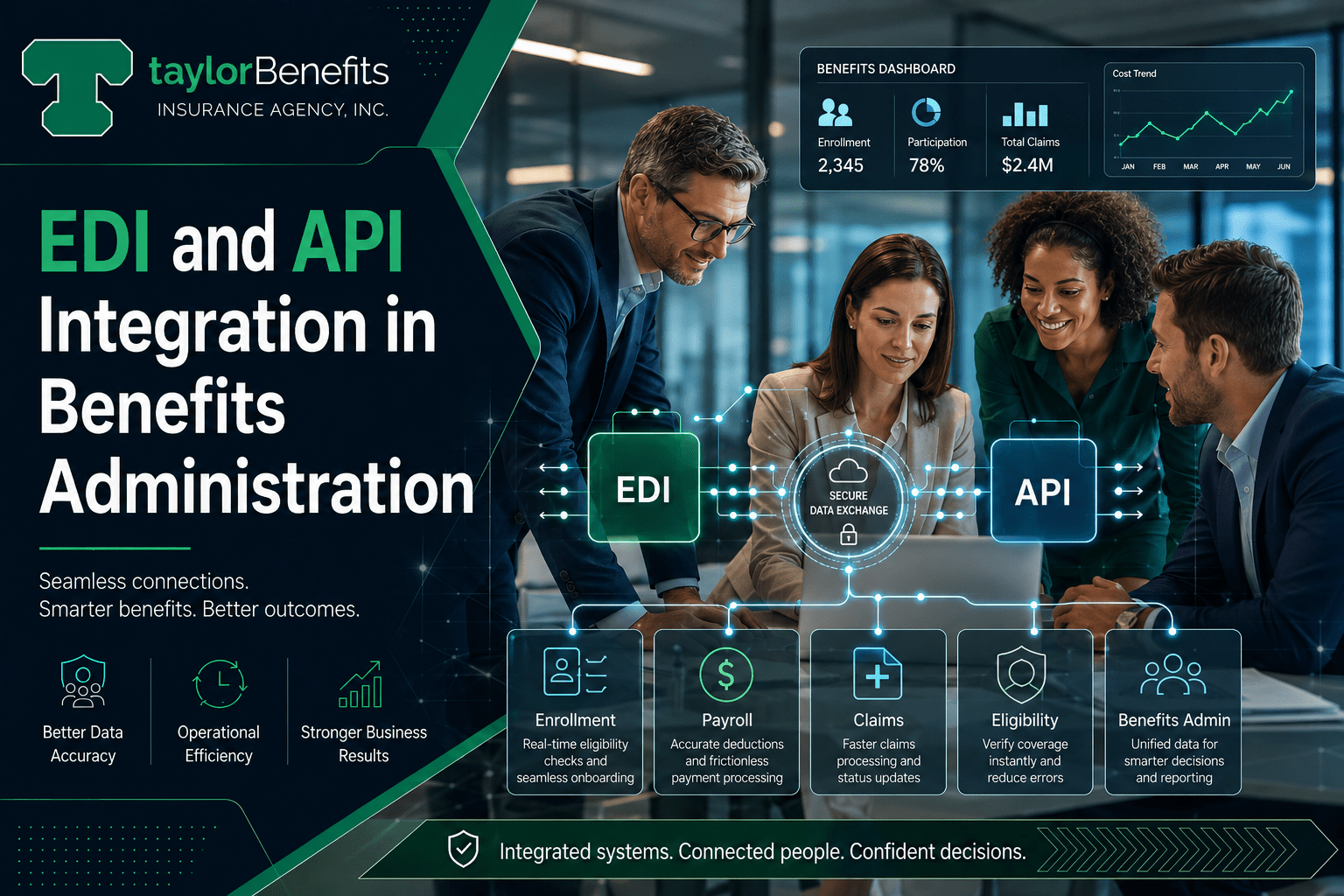
The most common source of employee benefits problems in 2026 is not poor plan design or inadequate communication — it is broken data integration between the systems that administer those benefits. When an employee’s enrollment doesn’t reach the carrier on time, when a dependent is dropped from coverage because a termination wasn’t transmitted correctly, when an employee continues to be billed for coverage they elected to drop, or when carrier and benefits administration platform records don’t match — the root cause is almost always a failure in the data integration layer connecting the employer’s systems to the vendors administering coverage.
These failures are not minor administrative annoyances. They produce real coverage gaps that affect employees during medical crises, real billing errors that consume HR time to resolve, real compliance issues with eligibility tracking, and real reputational damage when employees lose trust in their benefits program. The cost is largely invisible until something breaks, at which point it becomes acutely visible.
The technologies that connect these systems — primarily EDI (Electronic Data Interchange) and modern APIs — have been the backbone of benefits administration for decades and have evolved substantially. But the quality of integration employers actually receive varies enormously across vendors, and most employers don’t know what to ask for or what to evaluate. This article covers what employers should understand about integration, what to demand from vendors, and how to recognize when integration is the source of problems that may appear unrelated.
Benefits administration involves continuous data exchange between multiple systems. The employer’s HRIS or payroll system contains employee data — names, dates of birth, addresses, employment status, dependent information. The benefits administration platform manages enrollment data. Each carrier needs current information about every covered member. The PBM needs pharmacy eligibility data. The COBRA administrator needs termination data. The 401(k) recordkeeper needs contribution data.
In a properly integrated benefits ecosystem, all of this data flows automatically between systems on appropriate schedules, with errors caught and corrected before they affect employees. In a poorly integrated ecosystem, data is moved manually, files are transmitted but not validated, errors accumulate unaddressed, and inconsistencies surface as employee-facing problems.
Two primary technologies enable this data exchange:
The traditional method, dating back decades. EDI transmits standardized files between systems on regular schedules — typically daily or weekly. The most common formats include ANSI X12 standards (834 for enrollment data, 820 for premium remittance) that virtually every carrier accepts. EDI is reliable, widely supported, and well-understood, but it operates in batches rather than real time and has limited error-handling.
The modern method. APIs allow systems to communicate in real time, sending and receiving specific data points as needed rather than transmitting full files on schedules. Modern benefits administration platforms increasingly use APIs to connect to carriers, with EDI as a fallback for carriers whose systems don’t yet support APIs. APIs enable real-time error checking, immediate transaction confirmation, and more sophisticated workflows than batch-based EDI can support.
Most current ecosystems use a hybrid approach — APIs where available, EDI elsewhere — with integration quality varying significantly based on platform, carriers involved, and how connections have been configured.

The failure modes in benefits administration integration are consistent and recognizable. Understanding them is the foundation for knowing what to demand from vendors.
Enrollment data not reaching the carrier on time. New hires enrolling in coverage who don’t appear in carrier records for days or weeks after their effective date. The employee tries to use coverage, the provider can’t verify eligibility, and the friction lands on HR to resolve.
Terminations not transmitted promptly. Employees who terminate continue to appear active in carrier records for weeks, producing premium overpayment and coverage that legally shouldn’t exist. Cleanup is administratively burdensome and often involves retroactive adjustments.
Dependent data inconsistencies. A dependent dropped during open enrollment but still active in carrier records. A new dependent added but not transmitted. The employee discovers the discrepancy when trying to use coverage.
Mid-year change failures. Life event changes — marriages, births, dependent age-outs, employment status changes — that don’t propagate correctly across all systems.
Premium remittance discrepancies. The employer is billed for an active employee population that doesn’t match what the employer believes is active. Resolving these discrepancies consumes substantial HR and finance time.
Annual enrollment data transmission errors. Open enrollment elections that don’t transfer correctly to carriers, requiring extensive cleanup in January as employees discover their elections weren’t processed as expected.
Audit and reconciliation failures. Inability to reconcile what the employer thinks is enrolled, what the platform shows, and what the carrier records show — a sign that no party has clean, authoritative data and that integration errors have been accumulating.
Each of these is preventable with proper integration architecture, error handling, and ongoing monitoring. That they occur as commonly as they do reflects the quality of integration most employers actually receive — not what’s technically achievable.
When evaluating benefits administration platforms, carriers, and integration capabilities, the following requirements separate vendors who deliver reliable integration from those who don’t.
Demand specificity about how each carrier connection is established and how frequently data flows.
Vendors with strong integration commit to specific timelines (often “next business day for new hires and terminations”). Vendors with weak integration use vague language about “regular transmission” or extended timelines that don’t meet employee expectations.
Demand specificity about how errors are detected, communicated, and resolved.
Vendors with strong error handling have automated error detection, clear escalation pathways, and committed turnaround times. Vendors with weak handling produce errors that surface as employee complaints weeks later.

Demand specificity about how data accuracy is maintained over time.
Reconciliation is the maintenance function that prevents error accumulation. Vendors without strong reconciliation processes typically have accumulating discrepancies that no party has visibility into.
Demand specificity about reporting visibility.
Vendors with strong transparency provide reporting infrastructure that lets the employer monitor integration quality. Vendors with weak transparency surface problems only when something breaks visibly.
Demand specificity about how new carrier connections are established.
The connection quality between any specific benefits administration platform and any specific carrier varies. Vendors who have established, well-tested connections with your specific carriers will produce better results than those building those connections from scratch.
Demand specificity about data security and regulatory compliance.
These items are increasingly table stakes for any vendor handling protected health information, but explicit verification matters — particularly for smaller vendors whose security infrastructure may be less mature than enterprise-scale platforms.

For employers who already have benefits administration in place, periodic evaluation of integration health is the right ongoing discipline. Practical evaluation steps:
Not every integration problem requires a vendor change. Many problems are addressable through configuration changes, process improvements, or vendor accountability conversations. But some problems indicate structural vendor limitations that won’t be solved without a platform change.
Indicators that vendor change may be warranted:
For employers experiencing several of these simultaneously, evaluating alternative platforms with stronger integration capabilities is appropriate. The integration capabilities of modern enterprise-grade platforms have improved substantially, and the cost differential is often modest relative to the operational benefits.

Data integration is the invisible infrastructure of benefits administration. When it works, employees barely notice — coverage is active when expected, terminations are clean, life events processed correctly, and HR’s administrative burden is manageable. When it doesn’t, the resulting problems consume HR time, frustrate employees, and erode trust in the benefits program.
The technical capability to deliver high-quality integration exists. The variation in what employers actually receive reflects differences in vendor capabilities, configuration choices, and the level of accountability employers demand. Employers who treat integration as opaque vendor responsibility — accepting whatever quality they receive — get the market default. Employers who specify requirements, evaluate vendors against them, and maintain ongoing accountability get materially better results.
For 2026 vendor evaluations, integration capabilities deserve attention proportionate to their impact on benefits program performance. The questions in this article — connection type and frequency, error detection, reconciliation, transparency, implementation, and security — give employers a framework for that evaluation.
Taylor Benefits Insurance Agency helps employers evaluate benefits administration platforms and vendor integration capabilities as part of broader benefits strategy work. If your benefits administration is producing the kinds of integration problems described in this article, contact our team for a structured evaluation.
Before implementing benefits API integration, employers should review their current systems, data requirements, security needs, and vendor compatibility. A well-planned integration process helps prevent disruptions and ensures information moves correctly between platforms. Working with experienced providers can make the transition easier while improving efficiency and long-term benefits administration performance.

Todd Taylor oversees most of the marketing and client administration for the agency with help of an incredible team. Todd is a seasoned benefits insurance broker with over 35 years of industry experience. As the Founder and CEO of Taylor Benefits Insurance Agency, Inc., he provides strategic consultations and high-quality support to ensure his clients’ competitive position in the market.

We just started working with Taylor Benefits and could not be happier. Todd gave us quite the education as well as some time saving tools to help us manage our HR and save money too. We are looking forward to a long relationship!”
-Carol, Accounting Manager, recruitment marketing company, Campbell, CA
We’re ready to help! Call today: 800-903-6066