
- Providing world class service and value for employee benefit group plans since 1987
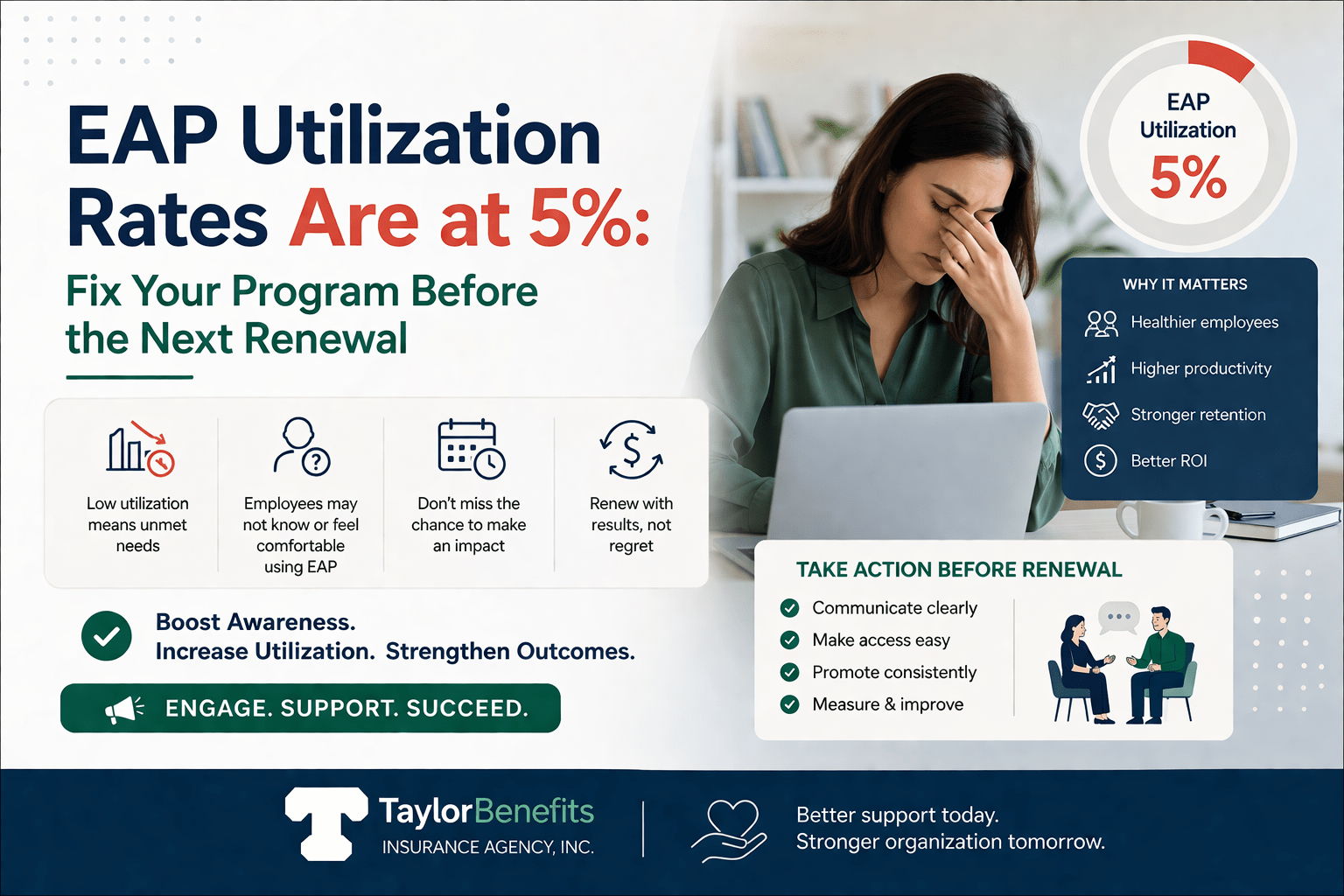
The Employee Assistance Program is one of the most consistently disappointing benefits in the employer-sponsored landscape. Industry-wide utilization data has held remarkably steady for years: most traditional EAPs report engagement rates between 3 and 8 percent of the eligible employee population, with the median sitting at approximately 5 percent. For a benefit specifically designed to address mental health, family stress, financial difficulty, substance abuse, and life crises — needs that affect a substantially larger percentage of any workforce — that utilization rate is not a minor performance issue. It’s a structural failure.
Five percent utilization means that for every 100 employees, 95 are not engaging with a program designed to support them through the most consequential challenges of their lives. The cost is not just the wasted EAP fee — it is the absence of intervention at moments when intervention would have changed outcomes. The employee facing a mental health crisis who never picks up the phone, the parent navigating a difficult adolescent transition without support, the worker with a substance use issue whose progression goes uninterrupted — these are real costs, even though they don’t show up on a benefits invoice.
The reasons EAPs underperform are recognizable, addressable, and almost never about employee disinterest in mental health support. They are about program design, vendor selection, communication, and integration choices that employers have control over. This article walks through the diagnosis and the practical steps to rebuild EAP performance before your next renewal.
The 5 percent utilization problem is not a mystery — it’s the predictable result of program characteristics that have persisted in the EAP market for decades. Understanding the causes is the first step in fixing them.
The single largest barrier to EAP utilization is the perception — accurate or not — that using the program will be visible to the employer in ways that affect career standing, performance evaluations, or workplace relationships. Employees considering reaching out to an EAP for mental health support, substance abuse concerns, or family crises frequently report that fear of disclosure is the primary reason they don’t.
Most EAPs are technically confidential, with strict separation between the EAP vendor and the employer. But the perception of confidentiality risk is often stronger than the reality, and most EAP communications inadequately address the perception. An employee who knows abstractly that the EAP is confidential may still hesitate to use it without explicit reassurance about specifically how confidentiality is structured and what information does and doesn’t flow to the employer.

Employees can’t use a program they don’t know exists or don’t remember exists. EAP awareness in most workforces follows a predictable pattern: a mention at onboarding that fades from memory within months, perhaps a reference in the annual benefits guide that few employees read, and otherwise no presence in employees’ awareness of available resources.
When a crisis occurs — the moment when the EAP would have value — the employee typically doesn’t remember they have access to one. They don’t know where to find the contact information. They don’t know what conditions or situations the program covers. The benefit exists, but it is functionally invisible at the moment it would matter.
Traditional EAP access requires calling a phone number — typically during business hours — to schedule an appointment. The intake process may require explaining the situation to a triage representative before being matched with a counselor. The first appointment may not be available for several days or longer. The counseling itself may be conducted in person at a location that’s not convenient for the employee.
This access model was designed in the 1980s and 1990s and has not kept pace with how employees expect to access services in 2026. Employees who can text their primary care doctor through a portal, schedule a medical appointment online, and conduct a video visit from their phone find traditional EAP access disproportionately friction-laden compared to other healthcare touchpoints.
Many traditional EAP programs offer 3 to 6 short-term counseling sessions per issue per year, plus referrals to longer-term care for those who need it. For employees facing minor situational stress, the model can work. For employees facing significant clinical mental health needs — depression, anxiety disorders, trauma processing, substance use disorders — the short-term counseling structure is often inadequate, and the referral to longer-term care typically lands the employee back in their regular health plan’s mental health coverage with no continuity from the EAP engagement.
The mismatch between the depth of services offered and the depth of services needed contributes to underutilization: employees who recognize their needs exceed what a brief EAP intervention can address often don’t engage at all.
Front-line managers and HR staff are the most likely first responders to employee crises — the manager who notices an employee struggling with performance issues, the HR partner handling a leave request that surfaces underlying mental health concerns. Effective EAP utilization requires these front-line responders to know how the EAP works, when to refer, and how to make that referral feel supportive rather than punitive.
In many organizations, manager training on EAP referral is minimal or nonexistent. The result is that the moments when EAP referral would be most valuable — when an employee’s struggles are first noticed by someone in a position to help — pass without the referral happening.
Most EAP vendors provide quarterly or annual utilization reports that emphasize aggregate engagement numbers — total cases opened, total counseling sessions delivered, total work-life consultations completed — without contextualizing these against meaningful benchmarks. The 5 percent utilization rate is presented as performance data without comparison to what utilization could be in a well-functioning program.
Employers reviewing these reports often have no basis for evaluating whether their program is performing adequately, and vendors have no incentive to highlight underperformance against potential.

The 5 percent benchmark reflects what most employer EAPs deliver. It is not what the best programs deliver, and it is not what employers should accept as adequate. Programs structured intentionally and operated with engagement focus consistently achieve materially higher utilization — often 15 to 30 percent of the eligible employee population over a 12-month period, with some programs reaching even higher rates in specific workforce contexts.
The performance gap between mediocre and strong EAP programs is one of the largest performance gaps in the benefits portfolio. The cost differential is modest — typically the difference between $1.50 and $5 per employee per month in pricing — and the engagement differential is substantial.
The patterns that distinguish high-performing programs:
Before evaluating whether to renew with the current EAP vendor, redesign the program structure, or change vendors entirely, conduct a structured assessment of where the current program is failing.
Request from your current EAP vendor:
What to look for: Annual utilization below 8 percent is below industry average. Below 5 percent suggests structural program failure. Single-session case patterns (most cases closing after one session) often indicate that employees are starting engagement and not finding enough value to continue.
Run a brief, anonymous survey of your workforce that asks:
Awareness rates below 70 percent (employees who know the program exists) suggest a communication failure that no amount of program improvement will overcome until it’s addressed. The free-text responses to “what would make you more likely to use it” frequently contain the most useful information about program failure modes — confidentiality concerns, perceived inadequacy of services, awareness gaps, access friction.

Survey or interview a representative sample of front-line managers about:
Manager capability gaps are common and underweight in most program evaluations. If managers don’t know how to make effective referrals, the EAP will underperform regardless of how good the program itself is.
Schedule a substantive review with your EAP vendor that goes beyond their standard quarterly report. Ask:
Vendors who can’t engage substantively with these questions — or who present the 5 percent utilization as adequate performance — are signaling that their program is not built for the engagement levels you should be seeking.
Based on the diagnostic assessment, the appropriate response falls into one of three categories.
Appropriate when the current vendor offers strong service capabilities that have been underutilized due to communication, integration, or activation failures rather than vendor-side limitations.
The work involves substantially redesigning how the program is positioned, communicated, and integrated within the workforce — without changing the underlying vendor. This is typically the lowest-cost path and can be effective when the vendor itself is competent.
Appropriate when the current vendor offers a basic EAP that has reached its performance ceiling, but the vendor offers expanded service tiers that would address the program’s structural limitations.
Many EAP vendors offer multiple service tiers — basic EAPs at $1 to $2 per employee per month, mid-tier programs at $3 to $5, and premium programs at $5 to $10+ that include modern access infrastructure, clinical depth, and integrated mental health support. Upgrading service tiers within the existing vendor relationship can be more efficient than vendor change while delivering substantial program improvement.
Appropriate when the current vendor’s structural limitations cannot be addressed within their service portfolio, when their performance against peer benchmarks is materially below industry leaders, or when the program’s positioning within the workforce has become so degraded that a fresh start with a new vendor would be more effective than attempting to rebuild the existing program.
The EAP market includes both traditional EAP vendors (legacy companies that have offered the service for decades) and newer mental health-first platforms (companies that have built their offering around modern access infrastructure and clinical depth). For employers prioritizing engagement and mental health outcomes, the newer platforms often deliver materially better performance than traditional vendors at competitive pricing.

For employers committed to improving EAP performance — whether through program redesign, vendor service expansion, or vendor replacement — the practical work involves several specific changes.
Confirm that the program (whether current vendor or replacement) offers:
Programs without these capabilities cannot achieve modern engagement rates regardless of other improvements.
Move beyond 3-to-6-session models toward:
Replace the once-a-year EAP mention in benefits materials with active, year-round communication:
Develop a manager training program covering:
This training should be required for all people managers, refreshed annually, and supported with reference materials managers can access at the moment they need them.
Build communication that directly addresses the confidentiality concerns that prevent utilization:
Move from passive utilization reporting to active performance management:

The 5 percent EAP utilization rate that has become the industry default is not an inevitable outcome — it is the result of program design, communication, and operational choices that employers can change. The cost of fixing it is modest. The value of fixing it — measured in better employee mental health outcomes, lower behavioral health claims, reduced absenteeism and turnover, and improved organizational culture — is substantial.
Before your next EAP renewal, run the diagnostic, decide between renewal with changes, vendor service expansion, or vendor replacement, and commit to the engagement infrastructure that distinguishes high-performing programs from the industry default. The employees who would benefit from EAP support — and who are not currently engaging — are not disinterested. They are responding rationally to a program that has not been designed, communicated, or operated to serve them effectively.
Fixing that is one of the highest-leverage benefits decisions available to most employers in 2026.
Taylor Benefits Insurance Agency works with employers to evaluate EAP performance, redesign program infrastructure, and identify replacement vendors when current programs have reached their performance ceiling. If your EAP utilization sits at the industry default and your next renewal is approaching, contact our team for a structured program review.
EAP service offerings, pricing, performance benchmarks, and vendor capabilities vary substantially across the market and are subject to ongoing change. The information in this article reflects general industry patterns as of late 2025 and should not be taken as a representation of any specific vendor’s services or performance. Consult a qualified benefits advisor regarding your specific situation.
Many employees hesitate due to privacy concerns, uncertainty about what is offered, or simply forgetting the benefit exists. Even when support is available, stigma around mental health or fear of workplace judgment can prevent people from reaching out. If communication is weak, the program often goes unused until a crisis becomes severe.
Regular communication, confidential access, manager awareness, and simple enrollment can improve EAP participation. Employees are more likely to use available support when they understand its value and trust their privacy.

Todd Taylor oversees most of the marketing and client administration for the agency with help of an incredible team. Todd is a seasoned benefits insurance broker with over 35 years of industry experience. As the Founder and CEO of Taylor Benefits Insurance Agency, Inc., he provides strategic consultations and high-quality support to ensure his clients’ competitive position in the market.

We just started working with Taylor Benefits and could not be happier. Todd gave us quite the education as well as some time saving tools to help us manage our HR and save money too. We are looking forward to a long relationship!”
-Carol, Accounting Manager, recruitment marketing company, Campbell, CA
We’re ready to help! Call today: 800-903-6066