
- Providing world class service and value for employee benefit group plans since 1987

It can be very stressful to lose a job and, in particular, health insurance. Employer-sponsored plans benefit millions of citizens in the US. And if you lose your job, unfortunately, you might not be covered in the meantime, and this would result in high medical expenses or the lack of timely medical care. The article discusses the principal methods of obtaining health insurance upon loss of employment, including immediate continuation plans, government subsidies, etc.
These paths will help you save your health and money during a period of transition. One should move fast since most of the options are time-bound. When you are going through the period of suspension or resignation, you must be aware about your rights as an employee, as this will help you in dealing with the issue; otherwise, you will face loss of your health care insurance.
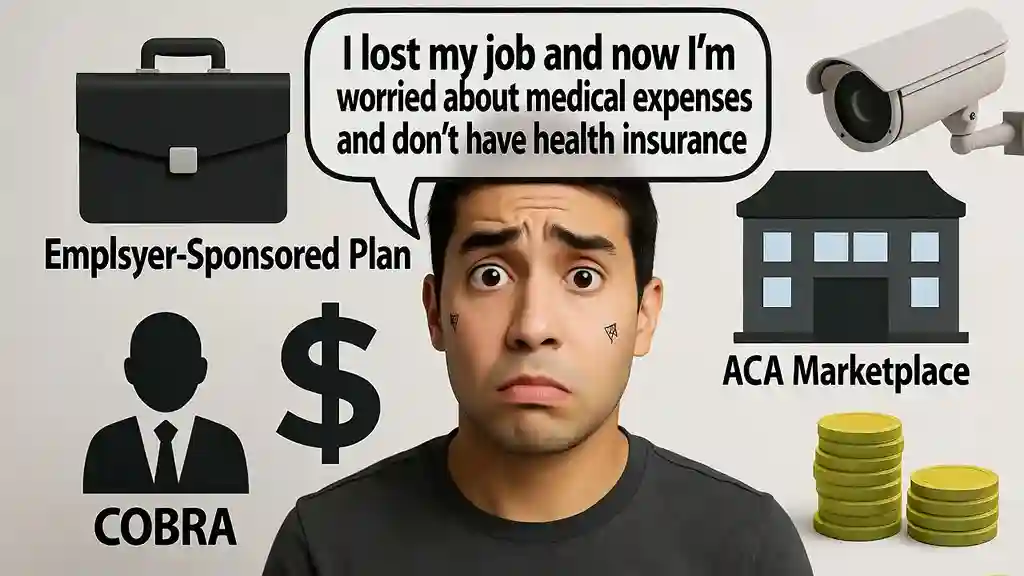
There are several options for health insurance coverage even after losing your job. These options may include policies driven by:
The federal plan will enable you to take up the employer group health plan of the company you lost your job in, covering up to 18-36 months, but you will pay the entire premium, along with a small fee. It is best in preserving the benefits and network of the same during transitions, but without subsidies, the expense may be high.
The Affordable Care Act (ACA) allows you to sign up for individual plans at Healthcare within a 60-day special enrollment period that is triggered by a loss of employment. Income-based subsidies also render it affordable, including essential benefits such as preventive care.
In low-income people, this state-federal program covers no cost or at reduced costs in case your income is below the levels (i.e., 138% of the federal poverty level in 40 expansion states as of 2025). Job loss is usually an automatic qualifier; no time limits to enroll.
When you lose employer coverage, as an individual 65 years of age or older, with a disability, or end-stage renal disease, Medicare enrollment without penalties would be permitted. It consists of hospital (Part A), medical (Part B), and optional drug coverage (Part D), and an 8-month special enrollment period by the end of six months after job loss, should you have yet to be enrolled in a group insurance program.
The necessary action in case of misfortune within a specific time is necessary in order to get your rights and avoid other problems.

First, you need to learn about coverage policies. In case of job loss, your health insurance, which was sponsored by your employer, does not necessarily stop immediately. The exact date will depend on the policy of your employer, but you will be covered up to the last day of the month you no longer work. As an example, when your final day is in the middle of the month, you may still receive benefits up to the end of that month.
But the question here is, how long do you keep health insurance after losing job? In most cases, your insurance terminates almost immediately after leaving, but federal regulations such as the Health Insurance Portability and Accountability Act (HIPAA) assure individuals with special conditions do not lose coverage immediately after switching plans. One of the life events that initiates special enrolment is losing your job. It is up to 60 days to select new coverage without the necessity to wait till open enrolment.
You should remember that there are important dates to follow:
Otherwise, you may be forced to wait before the next open enrolment period, which in the case of 2026 coverage is typically November 1, 2025, to January 15, 2026.
The first step that people undertake is the immediate continuation of programs as they desire to retain their current coverage. The Consolidated Omnibus Budget Reconciliation Act (COBRA) is a federal law that allows you to temporarily continue with your health insurance plan for some time after losing your job:
In case of small gaps when you have to fill them in, check whether your plan can enable you to enroll retroactively so that your coverage is not terminated.
The government-provided programs are cheap, particularly to individuals whose incomes are moderate. One of the primary sources of information is the Affordable Care Act (ACA) Marketplace. It offers subsidized plans depending on the amount of money you want to earn.
CHIP, or the Children’s Health Insurance Program, covers children in families that have higher incomes. You may make an application at your state Medicaid office. No enrolment time limit, you can apply anytime.
These plans are based on low cost, and Marketplace plans should have simple benefits such as mental health and preventive care.

Typical solutions are not the only ones that can fit your coverage needs, which are dependent upon your situation.
Take into account your health requirements, i.e., chronic conditions can be significant in the choice of broad-based coverage rather than bare-bones.
When individuals retire, they usually fear how they will obtain health insurance. These are the steps to follow to ensure a smooth transition:

During the coverage, you must consider the costs and the consequences. Marketplace plans can be as good as COBRA insurance with a little help in the form of subsidies, though premiums are very different.
| Option | Average Monthly Cost (Individual, 2025 Est.) | Deductible Range | Key Notes |
| COBRA | $500-$700 (full premium + 2% fee) | Same as the prior plan | Nonexistent subsidies; expensive to the unemployed. |
| ACA Marketplace (with subsidies) | $0-$400 (income-dependent) | $2,000-$8,000 | Tax credits lower the premiums; cost-sharing among people of low income. |
| Medicaid | $0 (if eligible) | Minimal | Financed on a state basis; pays the necessities. |
| Short-Term Plans | $100-$300 | $5,000+ | Few benefits; does not meet ACA requirements. |
Marketplace subsidy is an initial payment in terms of taxes, which can be altered at tax time. COBRA deductible can be itemized. To the extent possible, open a health savings account (HSA) and save up for emergencies. Whenever searching for a job, be sure to seek jobs with good benefits.
If you lose your job, you may worry about your insurance continuation, but there are policies such as COBRA, Health Insurance Marketplace, and Medicaid that will keep your insurance in check so you don’t have to lose more. Keep key deadlines in mind, such as the 60-day time limit, and do things speedily to remove gaps. The way to continue to receive crucial health care services is to determine what you require and make use of what you are able to.
If your new job’s health plan does not start immediately, you can avoid a gap in coverage. You may use the 60‑day special enrollment period after losing your previous job to get a Marketplace plan. You can also consider COBRA to continue your old coverage until your new plan begins. Compare costs and benefits to see which option works best for you and make sure your coverage starts as soon as your old plan ends.
You have the option to keep the current plan under COBRA or enroll in an ACA Marketplace plan within a special enrollment period, or seek Medicaid plan eligibility as per the income criteria, or seek short-term policies. You can receive individualized choices by either going to Healthcare.gov or by calling the insurance department of your state.
In such a case, whereby you obtain a loss of work, then the COBRA allows you to maintain the group health insurance of your employer up to 18 up to 36 months, yet at full cost. You are eligible to receive this in case your organization employs 20 or above employees. Smaller firms might be in similar mini-COBRA plans in states.
Yes, in case you lose your work, you will be entitled to enroll in ACA within a 60-day special enrollment period, although it does not have to be open enrollment. Subsidies may be cheaper depending on your income.
Other options include thinking of Medicaid, temporary insurance, or a subsidized Marketplace plan. In case of a layoff, claim unemployment benefits, which might pay the premiums, and explore free counseling at Healthcare.gov.
When taking unpaid leave, this does not imply the coverage will cease. In case of being laid off, it ends shortly. You can enroll in the Marketplace or COBRA. You will have 60 days to do so so as to avoid gaps.
You generally have a 60-day special enrollment period after losing coverage to enroll in a new health insurance plan. Acting quickly ensures continuous coverage and prevents gaps that could leave you financially vulnerable.
Losing employer coverage is considered a qualifying life event that may allow you to join a spouse’s workplace health plan outside the regular enrollment period. You typically have a limited window to apply, so notify the employer’s benefits administrator as soon as possible.
After losing job health coverage, you can apply for a Marketplace plan or choose COBRA within a 60 day window. Coverage loss is a qualifying event, so new plans can usually start the next month if you enroll quickly.
It depends on whether your doctor participates in the new plan's provider network. Before selecting a policy, check the insurer's directory or contact your healthcare provider to verify network participation. Doing so can help you avoid unexpected out-of-network costs.

Todd Taylor oversees most of the marketing and client administration for the agency with help of an incredible team. Todd is a seasoned benefits insurance broker with over 35 years of industry experience. As the Founder and CEO of Taylor Benefits Insurance Agency, Inc., he provides strategic consultations and high-quality support to ensure his clients’ competitive position in the market.

We just started working with Taylor Benefits and could not be happier. Todd gave us quite the education as well as some time saving tools to help us manage our HR and save money too. We are looking forward to a long relationship!”
-Carol, Accounting Manager, recruitment marketing company, Campbell, CA
We’re ready to help! Call today: 800-903-6066