
- Providing world class service and value for employee benefit group plans since 1987

You need to be familiar with some basic terminology of the complex world of health insurance so that you can make a smart decision about your coverage. One of such words is copay, which is rather significant in connection with the way you pay for medical care. This article discusses what is a copay in health insurance, its definition, operation, and how it interrelates with other aspects of insurance. These concepts should aid in ensuring that your healthcare expenses remain low, and you are either new to the insurance or are merely reviewing your plan.
To define copay, it is a predetermined sum of money that you are required to pay using your own money in case of receiving a covered healthcare treatment. The copay definition typically refers to this fixed amount, which varies according to the type of insurance you are on, as well as the type of treatment required on your part. As a case in point, you may have to spend $20 on a visit to a doctor and $100 on a visit to an emergency hospital.
The copay is a very easy idea to understand; you are required to pay a certain sum of money whenever it comes to medicine, a visit to a doctor, or a consultation with an expert. A copay is typically a fixed payment, and therefore, one can easily predict it. This is compared to other costs, which vary. Copayment meaning does not imply the same thing as copay. The two terms are used interchangeably in some plans, whereas some have copay as the services, and copayment as the prescriptions.

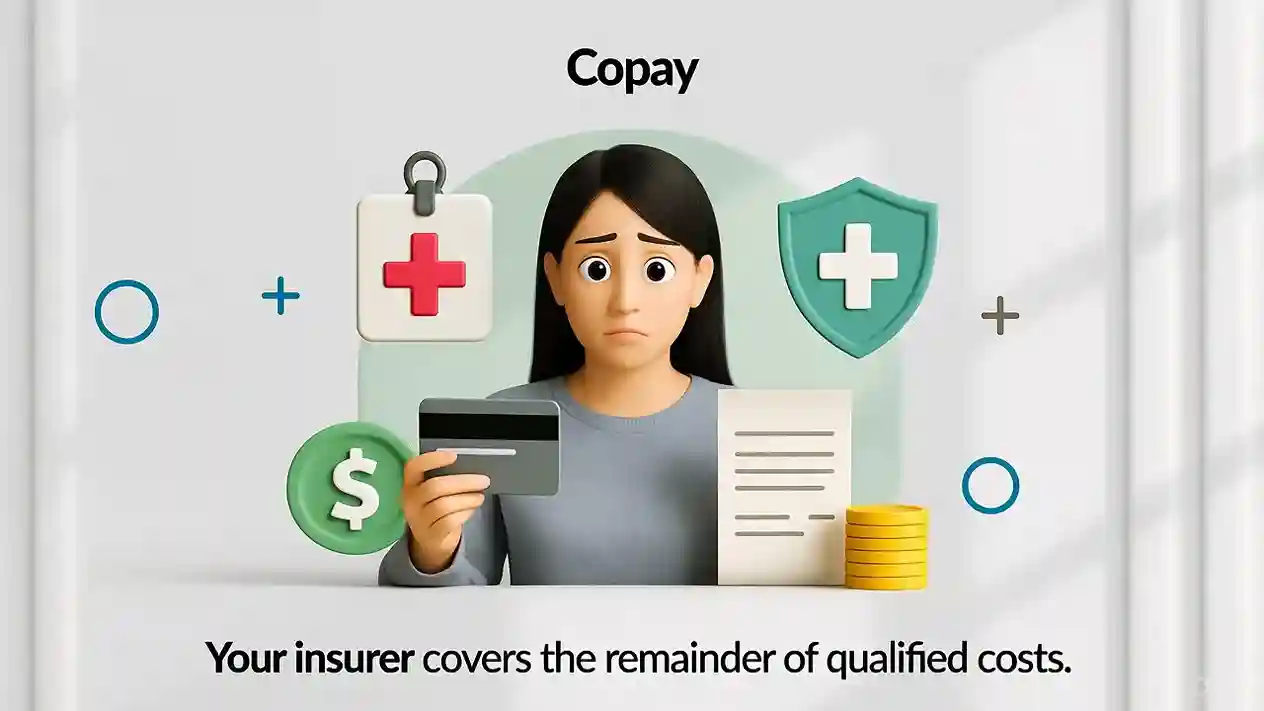
It means that your insurer will cover the remainder of the qualified costs when you make your copay, provided you are able to do so within the limitations of your plan. Such an arrangement will facilitate the accessibility of care required by policyholders without the necessity to cover the entire cost at once.
Copays are found in most health insurance plans, including HMOs, PPOs, and employer-provided health insurance plans. You present your insurance card to the medical practitioner, who takes your copay prior to or after the medical care. The insurance company then makes up the remainder without taking into consideration any deductibles or coinsurance.
The following are some of the common scenarios in which you may be required to make a copay:
These sums are mentioned in the list of benefits of your plan. You have to keep in mind that copays might not be charged for preventive services; rather, these services are covered by the Affordable Care Act (ACA).

For your better understanding, let’s now compare copays with other form of expenses that are out-of-pocket. The following is a table of the differences:
| Term | Definition | When It Applies | Fixed or Variable? |
| Copay | A fixed price is charged on certain services. | When the service is rendered, in most cases, prior to the deductible. | Fixed |
| Deductible | How much do you have to pay before insurance covers you? | On most services, per annum until met. | Variable (total amount) |
| Coinsurance | A percentage of expenses that you incur following a deductible. | Following the deductible, in case of covered services. | Variable (percentage) |
This analogy demonstrates that copays will provide you with a definite idea of the amount you will need to pay, whereas the deductibles and coinsurance might make the expenses more dynamic.
Is the copay applied to the deductible? It depends on your plan. In most situations, copays are not applied to your deductible; they are independent of treatments. However, there are health plans with high deductibles that also can count copays as part of the deductible when some limits are met (so-called copay-based health plans). This may save you a lot of money annually by ensuring that you verify your policy documents or call your insurance company to inquire to ensure that you are certain about the amount of money you will spend.

Copays have numerous advantages:
A con is that frequent visits may result in a high number of copays, which could be accumulated. In case of an ongoing condition and severe doctor’s visits, consider insurance options that have a lower copay or limit on the amount of money that you have to pay out of pocket.

Copay refers to the amount that will be paid to your insurance plan towards medical care. You are charged for it upon receiving the service, and the rate charged varies with the kind of treatment.
The copay is the fixed amount that you need to pay to get medical attention, and this makes expenditures easier to plan. This is different from coinsurance, which is a percentage.
Copayment has the same meaning as copay, which is normally applied in regard to medical costs or services. It is a predetermined price between you and your insurance company.
Copay definition refers to a fixed amount that you have to pay for some treatments as part of your health plan. There is no big difference in the overall bill.
Copays are fixed amounts, whereas deductibles are annual amounts. It facilitates easy access to cheaply obtained care for people.
People will use the knowledge of a copay in health insurance to maximize their plan. A copay will allow you to figure out your costs in healthcare and choose plans that are viable, as long as you understand what a copay is, what the difference between a copay and a deductible is, and whether a copay will count or not count towards your deductible. These are the smaller things that you might want to pay attention to in regard to your policy, and you might also consider consulting professionals to get expert advice to ensure that you do not come out of the blue and to reap the maximum benefits.
Most health insurance plans reset copays when a new plan year begins. You’ll pay the regular copay for visits or prescriptions again once your coverage renews. It’s a good idea to review your plan details to know when your benefits start over.
Out-of-network care may involve higher copays or require full payment upfront, depending on the plan. Some policies replace copays with coinsurance for out-of-network services, leading to increased costs for the patient.
Most health plans require a copay when you fill a prescription. The amount may vary depending on whether the drug is generic, brand name, or a specialty medication.
Urgent care usually has a lower copay than emergency room visits. Emergency care is more expensive due to higher resources and priority treatment, so insurance plans set higher copay amounts for those situations.
Employers often have several plan options with different copay structures when selecting group health coverage. Choosing higher copays may lower monthly premiums, while lower copays usually increase premium costs.

Todd Taylor oversees most of the marketing and client administration for the agency with help of an incredible team. Todd is a seasoned benefits insurance broker with over 35 years of industry experience. As the Founder and CEO of Taylor Benefits Insurance Agency, Inc., he provides strategic consultations and high-quality support to ensure his clients’ competitive position in the market.

We just started working with Taylor Benefits and could not be happier. Todd gave us quite the education as well as some time saving tools to help us manage our HR and save money too. We are looking forward to a long relationship!”
-Carol, Accounting Manager, recruitment marketing company, Campbell, CA
We’re ready to help! Call today: 800-903-6066