
- Providing world class service and value for employee benefit group plans since 1987

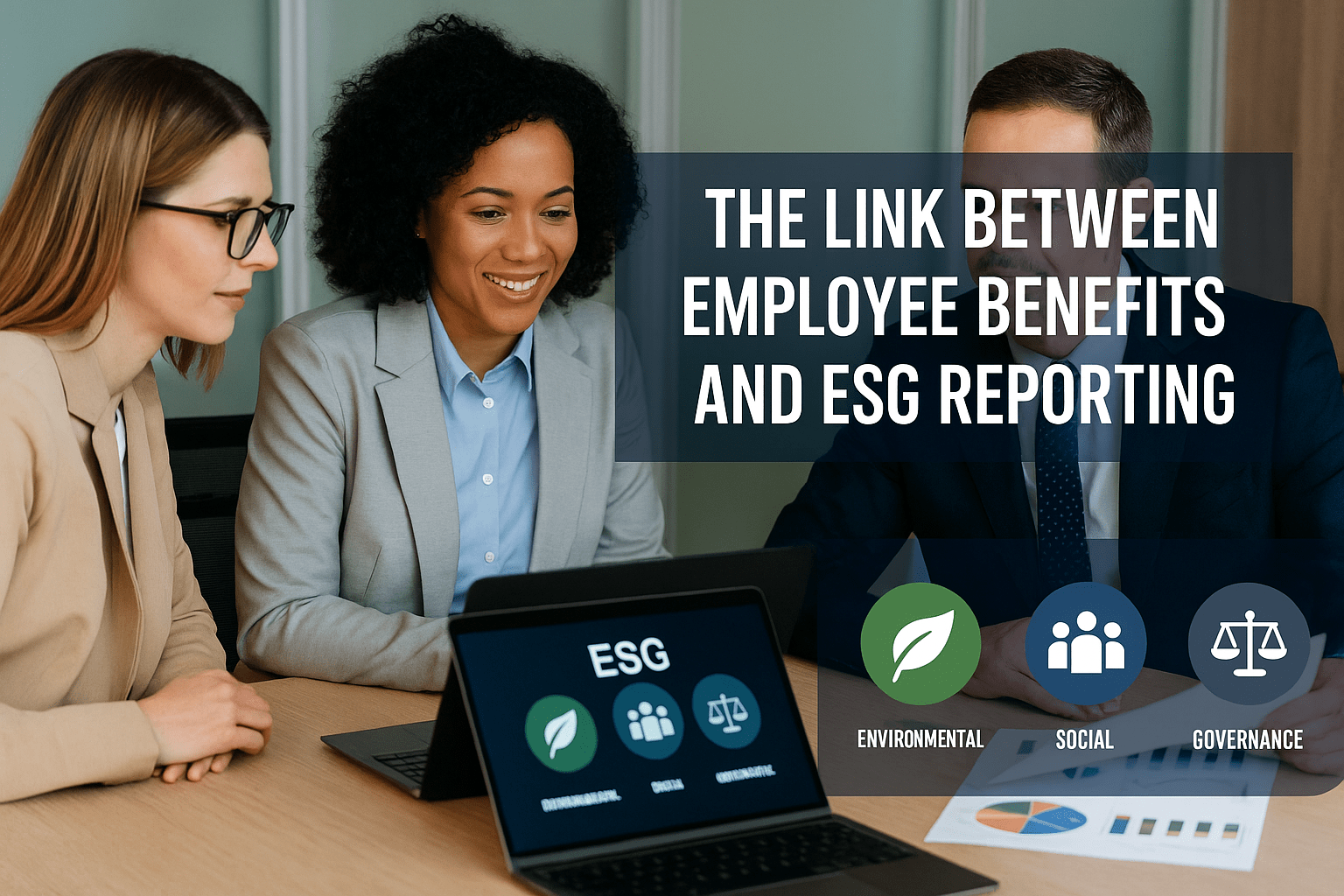
In today’s business landscape, success is no longer measured solely by profit margins. Increasingly, companies are being evaluated on how responsibly they operate — not just by investors, but by employees, customers, and the public.
This shift has given rise to ESG (Environmental, Social, and Governance) reporting — a framework that helps organizations measure their impact on society and the planet. While many think of ESG in terms of carbon emissions or ethical supply chains, a growing number of leaders are realizing that employee benefits are just as integral to a company’s social and governance performance.
Employee benefits are where a company’s values meet its actions. They influence health, equity, financial well-being, and overall culture — all core elements of the “Social” pillar of ESG. And as reporting standards evolve, businesses are being asked to quantify and disclose how their benefits programs support sustainability, inclusion, and governance goals.
At Taylor Benefits Insurance Agency, we help employers design benefit strategies that don’t just attract talent — they strengthen ESG outcomes, enhance transparency, and build long-term trust with stakeholders.
Before we explore the connection to employee benefits, it’s important to understand ESG at a high level.
Covers a company’s impact on the planet — energy use, carbon footprint, waste management, and sustainability initiatives.
Focuses on how an organization manages relationships with employees, customers, and communities. This includes diversity, workplace safety, labor practices, compensation fairness, and employee well-being.
Encompasses leadership ethics, transparency, board diversity, and accountability structures.
Together, these three dimensions form the foundation for how businesses demonstrate their long-term responsibility and resilience.
And while “Environmental” often gets the spotlight, it’s the Social and Governance pillars — both deeply tied to employee benefits — that shape the lived experience of a company’s workforce.
 The Social Pillar: Employee Benefits as a Measure of Corporate Responsibility
When it comes to ESG, the “S” is increasingly being defined by how companies treat their people. Benefits programs, once seen purely as a retention tool, are now a visible reflection of corporate ethics and social impact.
A company’s healthcare and wellness offerings signal how much it values employee health — physically, mentally, and financially. Comprehensive group medical coverage, mental health access, and wellness initiatives demonstrate genuine investment in people’s lives.
ESG-conscious employers go beyond compliance. They implement equitable, inclusive benefits that address disparities in access and outcomes. For example:
Offering mental health benefits across all coverage levels.
Including fertility, family planning, and gender-affirming care.
Providing telehealth for remote or rural employees.
Such choices reinforce a culture of care and respect — key to the “Social” dimension of ESG.
Diversity, Equity, and Inclusion (DEI) isn’t just about hiring practices — it’s also about how benefits are distributed and communicated.
Equitable benefits ensure that all employees — regardless of gender, family structure, income, or geography — have meaningful access to the same quality of care.
For instance, forward-thinking companies now:
Extend parental leave to all caregivers, not just mothers.
Offer domestic partner coverage.
Design flexible benefits that accommodate different cultural and family needs.
When employers address these inequities through benefits, they actively contribute to their ESG story.
Financial wellness programs — from 401(k) matching to student loan assistance — are another critical part of ESG.
They reflect a company’s commitment to long-term employee stability. In fact, financial health is one of the strongest predictors of overall well-being, and organizations that support it demonstrate true social stewardship.
Taylor Benefits often helps employers integrate such programs to show measurable impact in ESG disclosures — particularly around financial literacy, savings participation, and economic inclusion.

The “G” in ESG focuses on ethical leadership, fair decision-making, and transparent operations. While this may seem distant from employee benefits, it’s more connected than many realize.
Good governance in benefits means ensuring fairness in plan design, funding, and administration. Employers must ensure all eligible employees have access to the same opportunities, and that decisions — like contribution rates or coverage tiers — are data-driven and equitable.
Transparent communication about costs, changes, and eligibility fosters trust and minimizes compliance risk.
Adhering to laws like ERISA, ACA, HIPAA, and COBRA is not just a regulatory requirement — it’s a governance indicator.
Strong compliance processes demonstrate an organization’s commitment to ethical management. ESG reporting increasingly references employee benefits compliance as a marker of good corporate governance.
Taylor Benefits helps employers navigate these obligations through audits, documentation, and reporting support — ensuring their benefits administration stands up to governance scrutiny.
Governance extends to the partners and vendors companies choose. Selecting transparent, ethical insurers, TPAs, and PBMs is an ESG decision in itself.
Employers are now evaluating:
How vendors disclose pricing and rebates.
Whether partners align with sustainability and DEI commitments.
How benefits vendors manage their own ESG impact.
This level of scrutiny is becoming standard in corporate ESG assessments.

As ESG disclosure frameworks evolve, employee benefits are becoming a quantifiable component of social and governance reporting.
Frameworks like SASB (Sustainability Accounting Standards Board) and GRI (Global Reporting Initiative) now include metrics related to employee health, safety, diversity, and well-being.
For example:
SASB Human Capital Metrics assess employee benefits, wellness programs, and turnover.
GRI 401-2 asks companies to report benefits available to full-time and temporary employees.
This means that HR and benefits data are no longer internal metrics — they’re external signals of corporate responsibility.
Tracking benefits data — like participation rates, preventive care usage, and wellness engagement — provides measurable indicators of social performance.
For instance:
High engagement in wellness programs can demonstrate a commitment to employee health.
Equitable plan design across genders and job levels shows social fairness.
Benefits tied to sustainable lifestyle choices (like bike-to-work programs) support environmental and social goals simultaneously.
Modern benefits administration systems allow companies to collect and report data aligned with ESG frameworks. Analytics tools can show correlations between benefit usage and outcomes like retention, satisfaction, and productivity.
Taylor Benefits partners with clients to ensure these insights are captured and presented effectively in annual ESG reports — helping employers tell a more complete and credible story.
Integrating ESG principles into employee benefits isn’t just about reporting; it’s about aligning values, actions, and accountability.
Here’s how employers can build ESG-aligned benefits programs:
Assess current benefits offerings through an ESG lens. Identify areas where gaps may exist — for example, limited mental health access, inequitable parental leave, or opaque vendor practices.
Clarify which ESG goals your benefits program can support. For instance:
Improving employee well-being (Social).
Ensuring fair vendor relationships (Governance).
Encouraging sustainable commuting or wellness habits (Environmental).
Develop internal dashboards to track benefits data that aligns with ESG reporting frameworks. Transparency in cost, utilization, and impact is key.
Educate employees about how benefits support ESG values. When workers understand that their employer’s commitment to equity and well-being goes beyond words, engagement grows organically.
Working with a knowledgeable benefits broker — like Taylor Benefits Insurance Agency — ensures your benefits strategy not only aligns with ESG principles but also remains cost-effective, compliant, and competitive.

At Taylor Benefits Insurance Agency, we recognize that the future of employee benefits isn’t just about healthcare — it’s about purpose.
We help employers:
Design benefits that reflect fairness, transparency, and inclusion.
Integrate DEI and health equity initiatives.
Evaluate vendors through an ESG lens.
Gather and interpret benefits data for ESG disclosures.
Communicate the connection between benefits and corporate responsibility to employees and stakeholders.
With our expertise, employers can demonstrate — with clarity and confidence — how their benefits strategy supports broader ESG commitments.
The next generation of employees expects their employers to stand for something meaningful. ESG is not just a reporting requirement; it’s a blueprint for responsible leadership.
In the coming years, employee benefits will become even more central to that narrative — reflecting how companies care for their people, manage their resources, and uphold ethical governance.
Organizations that integrate ESG principles into their benefits strategy today won’t just meet disclosure expectations; they’ll lead with authenticity, attract top talent, and build resilience for the future.
Employee benefits are more than just perks — they’re proof of a company’s values in action.
As ESG reporting becomes standard, the link between benefits and corporate responsibility is undeniable. Transparent, equitable, and purpose-driven benefits programs are quickly becoming one of the most powerful ways employers can demonstrate their commitment to doing good while doing well.
At Taylor Benefits Insurance Agency, we help employers bridge that connection — designing employee benefits that strengthen your people, your culture, and your ESG story.
Because in the modern workplace, caring for your employees is caring for your business — and for the world around it.
Companies can measure impact by tracking participation in programs like health, wellness, and financial support. They should also look at how benefits are accessed across different employee groups to ensure equity. Reporting should combine these numbers with explanations of how the programs support the company’s ESG objectives and any steps being taken to improve outcomes.
Organizations often optimize ESG alignment by reallocating existing benefit spend toward preventive care, wellness initiatives, and flexible benefits that improve outcomes while reducing long-term claims and turnover expenses.
Wellness programs improve employee health, productivity, and satisfaction, which strengthens the social component of ESG reporting. Companies can track participation and outcomes to demonstrate commitment to workforce well being and responsible business practices.
Inclusivity ensures that benefits meet the needs of a diverse workforce, including different age groups, genders, and cultural backgrounds. When benefits are inclusive, employees feel valued and supported. This strengthens ESG social performance by promoting equality, reducing bias, and improving overall workplace engagement and satisfaction.
Yes, employee benefits can help attract talent by showing a company’s commitment to responsible workplace practices. Candidates often look for employers that prioritize employee well-being, fairness, and long-term support. Benefits connected to ESG values, such as health support, financial security, and inclusive programs, can improve employer reputation and make organizations more appealing to prospective employees.

Todd Taylor oversees most of the marketing and client administration for the agency with help of an incredible team. Todd is a seasoned benefits insurance broker with over 35 years of industry experience. As the Founder and CEO of Taylor Benefits Insurance Agency, Inc., he provides strategic consultations and high-quality support to ensure his clients’ competitive position in the market.

We just started working with Taylor Benefits and could not be happier. Todd gave us quite the education as well as some time saving tools to help us manage our HR and save money too. We are looking forward to a long relationship!”
-Carol, Accounting Manager, recruitment marketing company, Campbell, CA
We’re ready to help! Call today: 800-903-6066