
- Providing world class service and value for employee benefit group plans since 1987
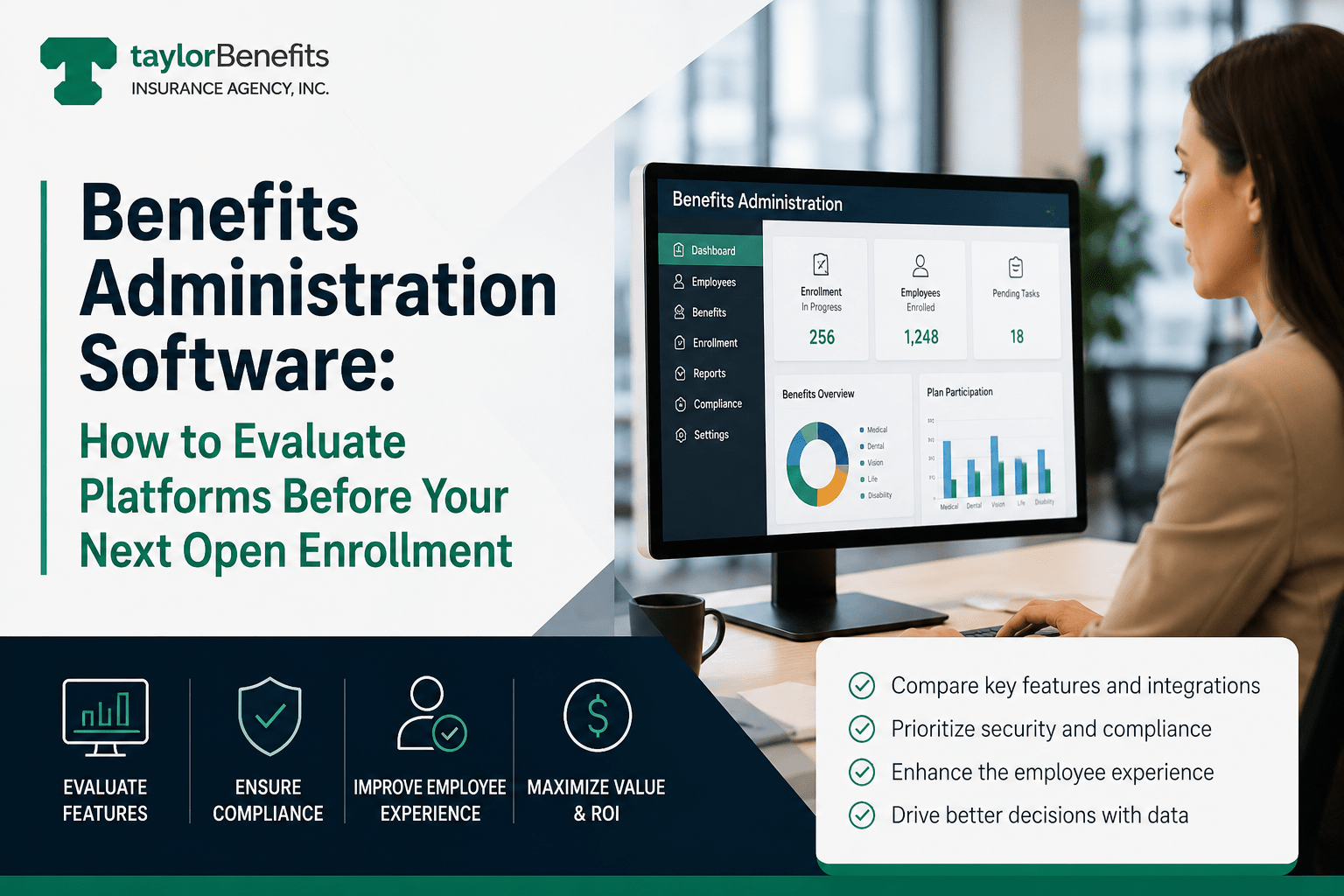
The benefits administration platform an employer chooses affects almost every dimension of how their benefits program functions: how employees enroll, how data flows to carriers, how compliance reporting is generated, how employees access plan information throughout the year, and how much administrative time the HR team spends on benefits versus other work. Despite this, many employers make benefits administration platform decisions reactively — typically in response to a carrier change, broker recommendation, or service problem with an incumbent vendor — rather than through deliberate evaluation against current capabilities and future needs.
The benefits administration platform market has matured significantly in recent years. Modern platforms offer capabilities that earlier-generation systems didn’t provide, including modern mobile experiences, decision-support tools, integrated communication platforms, sophisticated reporting, and increasingly capable carrier API connections. The variation in capability across platforms is substantial, and the gap between a well-chosen platform and a poorly-chosen one shows up in employee experience, HR efficiency, and benefits program effectiveness.
This article covers what employers should evaluate when selecting or replacing a benefits administration platform, what capabilities matter most, and how to structure the decision before the next open enrollment cycle.
Before evaluating specific platforms, it helps to be clear about what these systems do. A modern benefits administration platform typically handles:
Beyond these core functions, modern platforms increasingly include decision-support tools, communication capabilities, total compensation statement generation, and integration with adjacent systems like HRIS platforms, payroll, and wellness programs.

When evaluating benefits administration platforms, the following criteria typically distinguish strong choices from weak ones.
This is among the most important and most variable factors across platforms. The platform’s ability to maintain reliable, accurate, and timely data connections with each of your carriers directly affects whether employee enrollments and changes actually reach carriers correctly.
Key questions:
The integration quality is detailed enough that it warrants a dedicated discussion separate from the broader platform evaluation. For employers with specific carriers in mind, the platform’s existing relationships and integration history with those carriers should be confirmed before selection.
The employee-facing experience increasingly determines whether the benefits program performs to its potential. Important capabilities include:
Platforms that prioritize HR administration over employee experience tend to produce passive enrollment patterns and low benefits engagement. Platforms with strong employee experience drive better outcomes across the entire benefits program.
ACA compliance, ERISA reporting, COBRA administration, and other regulatory requirements affect every employer benefits program. Platform compliance capabilities should include:
Platforms vary significantly in compliance sophistication. Smaller platforms or those primarily designed for very small employers may lack the compliance depth that mid-market and larger employers need.

The implementation process, moving from a current state to a new platform, is often where platform changes succeed or fail. Important considerations:
Vendors with strong implementation discipline produce smoother transitions than those whose implementation teams are under-resourced. Asking for references from recent implementations is a meaningful evaluation step.
The post-implementation service relationship affects whether the platform delivers ongoing value. Consider:
Service models vary from high-touch dedicated account management to self-service models with shared support resources. The right model depends on the employer’s internal HR capacity and complexity.
The platform’s reporting capabilities determine the employer’s ability to manage the benefits program with data. Important capabilities:
Platforms with weak reporting capabilities produce HR teams that operate without visibility into benefits program performance.
The benefits administration platform doesn’t operate in isolation. Important integration considerations:
For employers with sophisticated HR technology ecosystems, integration capabilities are often the determining factor between platforms with otherwise similar feature sets.
Platform pricing models vary substantially:
The total cost of ownership across multiple years often differs materially from the headline PEPM rate, particularly for employers with many carriers or complex configurations. Multi-year total cost comparison produces better evaluation than year-one rate comparison.

The benefits administration platform market includes several distinct vendor categories, each with strengths and weaknesses.
The right category depends on employer size, complexity, HR technology stack, and benefits program characteristics.
For employers evaluating platforms, a structured process produces better decisions than reactive selection.

The benefits administration platform is foundational infrastructure that affects every aspect of how a benefits program functions. The platform decision deserves treatment proportionate to its impact — structured evaluation against documented requirements, reference validation, total cost analysis, and deliberate implementation timing.
Platform changes are operationally consequential and should not be undertaken lightly, but neither should an underperforming platform be retained indefinitely simply because change is inconvenient. The cost of staying with an inadequate platform — measured in employee experience, HR burden, integration problems, and benefits program effectiveness — typically exceeds the disruption cost of a well-managed transition.
For employers whose current platform is not delivering what their benefits program needs, the time to begin evaluation is well in advance of the next open enrollment cycle.
Taylor Benefits Insurance Agency helps employers evaluate, select, and implement benefits administration platforms as part of broader benefits program strategy. If you’re considering a platform change or want a structured evaluation of your current platform’s performance, contact our team for a consultation.
Benefits administration platform capabilities, pricing models, and market positioning continue to evolve. The information in this article reflects general market patterns and should not be taken as a representation of any specific platform’s current capabilities.
Yes, benefits administration software can reduce HR workloads by automating many routine tasks, including employee updates, enrollment tracking, and document management. Instead of managing information manually, HR teams can use the platform to organize processes more efficiently. This allows them to focus on employee support and other important workplace responsibilities.

Todd Taylor oversees most of the marketing and client administration for the agency with help of an incredible team. Todd is a seasoned benefits insurance broker with over 35 years of industry experience. As the Founder and CEO of Taylor Benefits Insurance Agency, Inc., he provides strategic consultations and high-quality support to ensure his clients’ competitive position in the market.

We just started working with Taylor Benefits and could not be happier. Todd gave us quite the education as well as some time saving tools to help us manage our HR and save money too. We are looking forward to a long relationship!”
-Carol, Accounting Manager, recruitment marketing company, Campbell, CA
We’re ready to help! Call today: 800-903-6066